French demonstrative adjectives are essential for beginners who want to speak and write French correctly. They help you point to a particular person, place, animal, or object by using words that mean this, that, these, and those in English.
Quick Answer: What Are French Demonstrative Adjectives?
French demonstrative adjectives are words used before a noun to identify a specific person or thing. The four forms are ce, cet, cette, and ces.
- Ce is used before most masculine singular nouns: ce livre (this/that book).
- Cet is used before masculine singular nouns beginning with a vowel or silent h: cet homme (this/that man).
- Cette is used before feminine singular nouns: cette maison (this/that house).
- Ces is used before all plural nouns: ces livres (these/those books).
Easy rule: Check whether the noun is singular or plural, identify its gender, and then choose the correct demonstrative adjective.
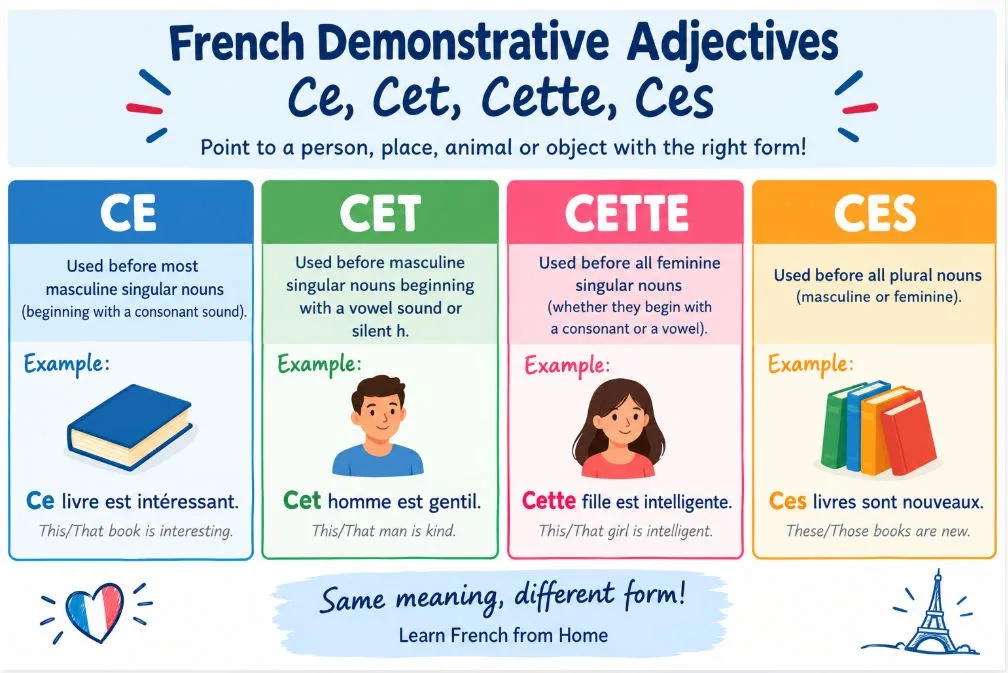
Table of Contents
- What Are French Demonstrative Adjectives?
- French Demonstrative Adjectives Chart
- Rules for Using Ce, Cet, Cette and Ces
- French Demonstrative Adjectives Examples
- How to Say This, That, These and Those in French
- How to Distinguish This from That
- Common Mistakes to Avoid
- Demonstrative Adjectives vs. Demonstrative Pronouns
- Practice Exercises with Answers
- Frequently Asked Questions
1. What Are French Demonstrative Adjectives?
French demonstrative adjectives, called les adjectifs démonstratifs in French, are used to point out or identify a particular noun.
In English, we use words such as this book, that girl, these flowers, and those houses. French uses ce, cet, cette, and ces for the same purpose.
Examples:
- Ce garçon est gentil. — This/That boy is kind.
- Cette fille est intelligente. — This/That girl is intelligent.
- Ces fleurs sont belles. — These/Those flowers are beautiful.
- Cet arbre est grand. — This/That tree is tall.
Notice that the demonstrative adjective comes directly before the noun or before an adjective that describes the noun.
For example:
- Ce livre — this/that book
- Ce grand livre — this/that big book
- Cette jolie robe — this/that pretty dress
The form changes according to the noun being described, not according to the person speaking.
2. French Demonstrative Adjectives Chart
The following table summarises all four forms.
| Gender and number | French form | English meaning | Example |
|---|---|---|---|
| Masculine singular, before a consonant sound | Ce | This/That | Ce garçon |
| Masculine singular, before a vowel or silent h | Cet | This/That | Cet homme |
| Feminine singular | Cette | This/That | Cette fille |
| Masculine or feminine plural | Ces | These/Those | Ces enfants |
Remember these four forms
Ce: masculine singular
Cet: masculine singular before a vowel or silent h
Cette: feminine singular
Ces: plural, masculine or feminine
There is no standard French demonstrative adjective cettes or cets. The plural form is always ces.
3. Rules for Using Ce, Cet, Cette and Ces
Let’s learn each form separately with examples.
Rule 1: Use Ce with Masculine Singular Nouns
Use ce before a masculine singular noun that begins with a consonant sound.
Examples:
| French | English |
|---|---|
| Ce livre | This/That book |
| Ce garçon | This/That boy |
| Ce stylo | This/That pen |
| Ce chien | This/That dog |
| Ce professeur | This/That teacher |
| Ce magasin | This/That shop |
Example sentences:
1. Ce livre est intéressant.
This/That book is interesting.
2. Je connais ce garçon.
I know this/that boy.
3. Ce chien est très mignon.
This/That dog is very cute.
4. J’aime ce restaurant.
I like this/that restaurant.
Tip: Use ce when the noun is masculine, singular, and begins with a consonant sound.
Rule 2: Use Cet Before Masculine Singular Nouns Beginning with a Vowel or Silent H
Use cet before a masculine singular noun that begins with a vowel sound or a silent h. This makes pronunciation smoother.
French vowels include a, e, i, o, and u, as well as certain other vowel sounds.
Examples:
| French | English |
|---|---|
| Cet ami | This/That friend |
| Cet arbre | This/That tree |
| Cet homme | This/That man |
| Cet hôtel | This/That hotel |
| Cet étudiant | This/That student |
| Cet appartement | This/That apartment |
Example sentences:
1. Cet homme est médecin.
This/That man is a doctor.
2. J’aime cet appartement.
I like this/that apartment.
3. Cet étudiant parle français.
This/That student speaks French.
4. Nous visitons cet hôtel.
We are visiting this/that hotel.
What happens when an adjective comes before the noun?
Choose the form according to the word immediately following the demonstrative adjective.
- Cet ancien château — This/That old castle.
- Ce beau château — This/That beautiful castle.
In the first example, ancien begins with a vowel sound, so cet is used. In the second, beau begins with a consonant sound, so ce is used.
Important exception: Not every written h is silent. French also has the h aspiré, which blocks this pattern. For example, héros takes ce: ce héros (this/that hero). Learn the correct form with the noun.
Rule 3: Use Cette with Feminine Singular Nouns
Use cette before all feminine singular nouns, whether they begin with a consonant or a vowel.
Examples:
| French | English |
|---|---|
| Cette fille | This/That girl |
| Cette maison | This/That house |
| Cette voiture | This/That car |
| Cette école | This/That school |
| Cette amie | This/That friend |
| Cette histoire | This/That story |
Example sentences:
1. Cette fille est sympathique.
This/That girl is friendly.
2. J’aime cette voiture.
I like this/that car.
3. Cette école est grande.
This/That school is big.
4. Cette amie habite à Paris.
This/That friend lives in Paris.
Remember: Even if a feminine noun begins with a vowel, use cette, not cet.
Correct: cette école
Incorrect: cet école
Rule 4: Use Ces with All Plural Nouns
Use ces before plural nouns, whether they are masculine or feminine.
Examples:
| French | English |
|---|---|
| Ces livres | These/Those books |
| Ces garçons | These/Those boys |
| Ces filles | These/Those girls |
| Ces maisons | These/Those houses |
| Ces amis | These/Those friends |
| Ces écoles | These/Those schools |
Example sentences:
1. Ces livres sont intéressants.
These/Those books are interesting.
2. Ces filles parlent français.
These/Those girls speak French.
3. Je préfère ces chaussures.
I prefer these/those shoes.
4. Ces étudiants sont intelligents.
These/Those students are intelligent.
The important thing to remember is that ces works for every plural noun. Do not try to create a separate masculine plural and feminine plural form.
4. French Demonstrative Adjectives Examples
Here are additional examples to help you recognise the correct form in everyday French.
| French sentence | English translation |
|---|---|
| Ce garçon est mon frère. | This/That boy is my brother. |
| Ce film est amusant. | This/That film is funny. |
| Cet oiseau est magnifique. | This/That bird is beautiful. |
| Cet exercice est facile. | This/That exercise is easy. |
| Cette robe est chère. | This/That dress is expensive. |
| Cette leçon est utile. | This/That lesson is useful. |
| Ces enfants jouent au parc. | These/Those children are playing in the park. |
| Ces fleurs sentent bon. | These/Those flowers smell nice. |
Examples with adjectives
Demonstrative adjectives can also be used before a noun that has another adjective.
- Ce petit chat — This/That little cat.
- Cet ancien ami — This/That former friend.
- Cette belle maison — This/That beautiful house.
- Ces grandes fenêtres — These/Those large windows.
Remember that cet depends on the sound at the beginning of the next word, not simply the first letter of the noun.
5. How to Say This, That, These and Those in French
English distinguishes between this and that, and between these and those. French generally uses the same demonstrative adjective for both meanings.
| English | French | Example |
|---|---|---|
| This book | Ce livre | Ce livre est neuf. |
| That book | Ce livre | Ce livre est ancien. |
| This man | Cet homme | Cet homme est gentil. |
| That man | Cet homme | Cet homme est mon voisin. |
| This house | Cette maison | Cette maison est jolie. |
| That house | Cette maison | Cette maison est grande. |
| These books | Ces livres | Ces livres sont nouveaux. |
| Those books | Ces livres | Ces livres sont anciens. |
The exact meaning comes from context, gestures, or additional words in the sentence.
6. How to Distinguish This from That in French
If you want to emphasise the difference between something near and something farther away, you can add -ci or -là after the noun.
- -ci generally indicates this or these.
- -là generally indicates that or those.
Examples:
| French | English |
|---|---|
| Ce livre-ci | This book |
| Ce livre-là | That book |
| Cette robe-ci | This dress |
| Cette robe-là | That dress |
| Ces chaussures-ci | These shoes |
| Ces chaussures-là | Those shoes |
Example sentences:
Tu préfères ce livre-ci ou ce livre-là ?
Do you prefer this book or that book?
Je veux acheter cette robe-là.
I want to buy that dress.
Ces chaussures-ci sont plus confortables.
These shoes are more comfortable.
This construction is especially useful when comparing two or more objects.
7. Common Mistakes to Avoid
Beginners often confuse ce, cet, cette, and ces. Here are the most common mistakes and their corrections.
| Incorrect | Correct | Explanation |
|---|---|---|
| Ce homme | Cet homme | Masculine noun beginning with a silent h |
| Cet fille | Cette fille | Fille is feminine |
| Cette livre | Ce livre | Livre is masculine in this meaning |
| Ces garçon | Ce garçon | Singular masculine noun |
| Cettes maisons | Ces maisons | The plural form is always ces |
| Cet école | Cette école | École is feminine |
| Ce amis | Ces amis | Amis is plural |
Mistake 1: Forgetting the gender of the noun
French nouns have grammatical gender. You should learn the noun together with its article whenever possible.
For example:
- le livre — the book, masculine
- la table — the table, feminine
Therefore:
- ce livre — this/that book
- cette table — this/that table
Mistake 2: Using cet before every noun beginning with a vowel
Cet is not a general alternative to ce. It is used with masculine singular nouns or adjectives beginning with a vowel sound or silent h.
Correct: cet arbre
Correct: cette amie
Incorrect: cet amie
Mistake 3: Confusing ces with ses
The words ces and ses sound alike in standard French pronunciation, but their meanings are different.
- Ces = these/those.
- Ses = his/her/its (possessive).
Examples:
Ces livres sont intéressants.
These/Those books are interesting.
Elle aime ses livres.
She likes her books.
Remember: ces points something out, while ses indicates possession.
8. Demonstrative Adjectives vs. Demonstrative Pronouns
Demonstrative adjectives and demonstrative pronouns are related, but they perform different grammatical functions.
A demonstrative adjective accompanies a noun. A demonstrative pronoun replaces a noun or noun phrase.
| Demonstrative adjectives | Demonstrative pronouns |
|---|---|
| Ce livre | Celui-ci |
| Cette voiture | Celle-ci |
| Ces garçons | Ceux-ci |
| Ces filles | Celles-ci |
Examples:
1. Je préfère ce livre.
I prefer this/that book.
Here, ce accompanies the noun livre.
2. Je préfère celui-ci.
I prefer this one.
Here, celui-ci replaces the noun phrase.
3. Cette voiture est rapide.
This/That car is fast.
Here, cette accompanies voiture.
4. Celle-ci est rapide.
This one is fast.
Here, celle-ci replaces the noun voiture.
Do not confuse ce, cet, cette, and ces with celui, celle, ceux, and celles. The first group accompanies nouns, while the second group can replace them.
9. Practice Exercises: French Demonstrative Adjectives
Test your understanding by choosing the correct demonstrative adjective in each sentence.
Fill in the blanks with ce, cet, cette, or ces.
- ______ garçon est mon ami.
- ______ homme est très gentil.
- ______ maison est magnifique.
- ______ enfants jouent au football.
- J’aime ______ école.
- ______ arbre est très vieux.
- ______ chaussures sont neuves.
- ______ livre est intéressant.
- ______ étudiante parle français.
- ______ appartement est grand.
Answers and Explanations
- Ce garçon est mon ami. — Masculine singular, consonant sound.
- Cet homme est très gentil. — Masculine singular, silent h.
- Cette maison est magnifique. — Feminine singular.
- Ces enfants jouent au football. — Plural noun.
- J’aime cette école. — Feminine singular, even though it begins with a vowel.
- Cet arbre est très vieux. — Masculine singular, vowel sound.
- Ces chaussures sont neuves. — Plural noun.
- Ce livre est intéressant. — Masculine singular, consonant sound.
- Cette étudiante parle français. — Étudiante is feminine singular.
- Cet appartement est grand. — Masculine singular, vowel sound.
Quick Self-Assessment
- 9–10 correct: Excellent! You understand the main rules.
- 7–8 correct: Good work! Review the difference between ce and cet.
- 5–6 correct: Practise noun gender and singular/plural forms.
- Fewer than 5 correct: Revisit the chart and try the exercise again.
10. Frequently Asked Questions About French Demonstrative Adjectives
1. What are the four French demonstrative adjectives?
The four forms are ce, cet, cette, and ces. They correspond to this, that, these, and those in English.
2. What is the difference between ce and cet?
Both are used with masculine singular nouns. Use ce before a consonant sound, as in ce livre, and cet before a vowel sound or silent h, as in cet arbre and cet homme.
3. When do we use cette in French?
Use cette before every feminine singular noun, regardless of whether it begins with a consonant or a vowel.
Examples: cette fille (this/that girl) and cette école (this/that school).
4. Is ces masculine or feminine?
Ces is used with all plural nouns, both masculine and feminine.
Examples: ces garçons (these/those boys) and ces filles (these/those girls).
5. Do French demonstrative adjectives distinguish between this and that?
No. Ce, cet, and cette can mean either this or that, while ces can mean these or those. Context usually clarifies the meaning. You can add -ci or -là after the noun to make the distinction more explicit.
6. What is the difference between ces and ses?
Ces means these or those, while ses means his, her, or its. They sound alike but have different meanings and grammatical functions.
7. Do demonstrative adjectives come before the noun in French?
Yes. They normally come directly before the noun or before an adjective that modifies the noun.
Examples: ce livre (this book) and cette belle maison (this beautiful house).
8. What is the difference between demonstrative adjectives and demonstrative pronouns?
Demonstrative adjectives accompany nouns, as in ce livre. Demonstrative pronouns replace nouns or noun phrases, as in celui-ci (this one).
Conclusion
French demonstrative adjectives are easy to learn when you remember four essential forms: ce, cet, cette, and ces.
Use ce for most masculine singular nouns, cet before masculine singular words beginning with a vowel sound or silent h, cette for feminine singular nouns, and ces for all plural nouns.
Practise these forms with everyday French vocabulary, read the examples aloud, and complete the exercises to strengthen your understanding.
Keep learning French with Learn French from Home, and explore more beginner-friendly French grammar lessons to improve your vocabulary and confidence.