
Quick Answer: What is the difference between futur proche and futur simple?
The futur proche is formed with the present tense of aller + an infinitive and often expresses plans, intentions, or future events connected to the present. The futur simple is formed using a future-tense verb form and often expresses predictions, promises, or future events presented more neutrally.
Examples:
- Futur proche: Je vais manger. — I am going to eat.
- Futur simple: Je mangerai. — I will eat.
Both tenses describe the future, but the difference is not simply how soon an event will happen. The speaker’s intention, perspective, and context help determine which form sounds most appropriate.
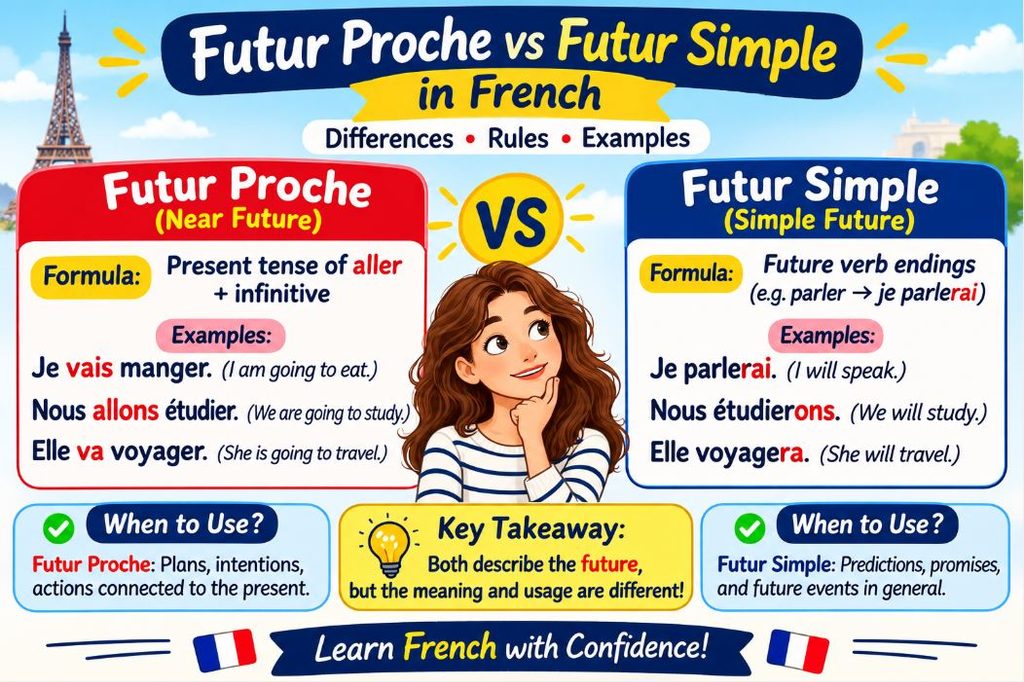
Table of Contents
- What Is Futur Proche?
- What Is Futur Simple?
- Futur Proche vs Futur Simple: Key Differences
- How to Form Futur Proche
- How to Form Futur Simple
- When to Use Futur Proche
- When to Use Futur Simple
- 15 Comparison Examples
- Negative Sentences and Questions
- Common Mistakes
- Exercises With Answers
- Frequently Asked Questions
1. What Is Futur Proche in French?
Futur proche, also called the French near future construction, is used to express plans, intentions, and events that are connected to the present situation.
It generally translates into English as “am going to,” “is going to,” or “are going to.”
Formula
Subject + present tense of aller + infinitive
Examples:
- Je vais étudier. — I am going to study.
- Tu vas travailler. — You are going to work.
- Elle va voyager. — She is going to travel.
- Nous allons apprendre le français. — We are going to learn French.
The verb aller changes according to the subject, but the main verb stays in the infinitive.
2. What Is Futur Simple in French?
Futur simple is the French simple future tense. It expresses future actions, predictions, promises, and events that the speaker presents as future possibilities or expectations.
It often translates into English as “will.”
Examples
- Je parlerai français. — I will speak French.
- Tu travailleras demain. — You will work tomorrow.
- Elle voyagera en France. — She will travel to France.
- Nous apprendrons le français. — We will learn French.
Unlike futur proche, futur simple uses a single conjugated verb form.
3. Futur Proche vs Futur Simple: Key Differences
| Feature | Futur proche | Futur simple |
|---|---|---|
| English equivalent | Going to | Often will |
| Formation | Present tense of aller + infinitive | Future stem + future endings |
| Example | Je vais partir. | Je partirai. |
| Typical use | Plans, intentions, events connected to the present | Predictions, promises, future statements |
| Everyday conversation | Very common | Also common, depending on context |
| Formal writing | Can be used | Frequently used |
| Distant future | Possible | Possible |
Remember: Futur proche does not always mean the event will happen immediately, and futur simple is not reserved for distant events. Both can describe tomorrow, next week, or next year.
The important distinction is how the speaker presents the future event.
4. How to Form Futur Proche
Futur proche is formed using the present tense of aller followed by an infinitive.
Present-tense conjugation of aller
| Subject | Aller | Example |
|---|---|---|
| Je | vais | Je vais manger. |
| Tu | vas | Tu vas manger. |
| Il / Elle / On | va | Elle va manger. |
| Nous | allons | Nous allons manger. |
| Vous | allez | Vous allez manger. |
| Ils / Elles | vont | Ils vont manger. |
English translations:
- Je vais manger. — I am going to eat.
- Tu vas manger. — You are going to eat.
- Elle va manger. — She is going to eat.
- Nous allons manger. — We are going to eat.
- Vous allez manger. — You are going to eat.
- Ils vont manger. — They are going to eat.
Notice that manger never changes.
For a more detailed explanation, read our Futur Proche in French: Rules, Examples & Exercises guide. Replace this example URL if your published article uses a different slug.
5. How to Form Futur Simple
To form futur simple for most regular verbs, use the infinitive as the base and add the future endings.
Futur simple endings
| Subject | Ending | Example with parler |
|---|---|---|
| Je | -ai | Je parlerai |
| Tu | -as | Tu parleras |
| Il / Elle / On | -a | Il parlera |
| Nous | -ons | Nous parlerons |
| Vous | -ez | Vous parlerez |
| Ils / Elles | -ont | Ils parleront |
For regular verbs ending in -re, remove the final e before adding the ending.
Examples:
- Finir → Je finirai. — I will finish.
- Vendre → Je vendrai. — I will sell.
- Prendre → Je prendrai. — I will take.
Some common verbs have irregular future stems:
| Infinitive | Future stem | Example |
|---|---|---|
| Être (to be) | ser- | Je serai |
| Avoir (to have) | aur- | J’aurai |
| Aller (to go) | ir- | J’irai |
| Faire (to do/make) | fer- | Je ferai |
| Venir (to come) | viendr- | Je viendrai |
| Voir (to see) | verr- | Je verrai |
| Pouvoir (to be able to) | pourr- | Je pourrai |
| Vouloir (to want) | voudr- | Je voudrai |
You will need to memorize these common irregular stems.
6. When to Use Futur Proche
A. To Talk About Plans
Use futur proche to describe an intention or plan connected to the present.
- Je vais étudier ce soir. — I am going to study tonight.
- Nous allons déménager l’année prochaine. — We are going to move next year.
- Elle va acheter une voiture. — She is going to buy a car.
Notice that the last two sentences can refer to events that are not immediate.
B. To Express Intentions
- Je vais apprendre le français. — I am going to learn French.
- Il va appeler son ami. — He is going to call his friend.
C. To Describe Something About to Happen
- Attention ! Tu vas tomber ! — Watch out! You are going to fall!
- Regarde le ciel ! Il va pleuvoir. — Look at the sky! It is going to rain.
Here, the present situation gives the speaker a reason to expect the event.
7. When to Use Futur Simple
A. To Make Predictions
- Un jour, les scientifiques trouveront peut-être une solution. — One day, scientists may find a solution.
- Il fera probablement beau demain. — The weather will probably be nice tomorrow.
B. To Make Promises
- Je t’aiderai. — I will help you.
- Je ne t’oublierai jamais. — I will never forget you.
C. To Express Future Events
- Nous partirons demain matin. — We will leave tomorrow morning.
- Le train arrivera à huit heures. — The train will arrive at eight o’clock.
Futur simple is especially useful in formal writing, announcements, and situations where the speaker presents a future event as a statement, prediction, or promise.
8. Futur Proche vs Futur Simple: 15 Comparison Examples
Compare these sentences to understand how the two tenses work.
| Futur proche | Futur simple | English meaning |
|---|---|---|
| Je vais manger. | Je mangerai. | I am going to eat / I will eat. |
| Je vais partir. | Je partirai. | I am going to leave / I will leave. |
| Tu vas étudier. | Tu étudieras. | You are going to study / You will study. |
| Elle va voyager. | Elle voyagera. | She is going to travel / She will travel. |
| Nous allons travailler. | Nous travaillerons. | We are going to work / We will work. |
| Vous allez réussir. | Vous réussirez. | You are going to succeed / You will succeed. |
| Ils vont arriver. | Ils arriveront. | They are going to arrive / They will arrive. |
| Je vais appeler Marie. | J’appellerai Marie. | I am going to call Marie / I will call Marie. |
| Il va pleuvoir. | Il pleuvra. | It is going to rain / It will rain. |
| Nous allons déménager. | Nous déménagerons. | We are going to move / We will move. |
| Elle va apprendre le français. | Elle apprendra le français. | She is going to learn French / She will learn French. |
| Tu vas comprendre. | Tu comprendras. | You are going to understand / You will understand. |
| Je vais faire mes devoirs. | Je ferai mes devoirs. | I am going to do my homework / I will do my homework. |
| Ils vont acheter une maison. | Ils achèteront une maison. | They are going to buy a house / They will buy a house. |
| Nous allons visiter Paris. | Nous visiterons Paris. | We are going to visit Paris / We will visit Paris. |
In many situations, both versions are grammatically correct. The best choice depends on context, intention, and the way the speaker wants to present the future event.
9. Negative Sentences and Questions
Negative form
In futur proche, place ne…pas around the conjugated form of aller.
- Je ne vais pas sortir. — I am not going to go out.
- Elle ne va pas venir. — She is not going to come.
In futur simple, place ne…pas around the conjugated future verb.
- Je ne sortirai pas. — I will not go out.
- Elle ne viendra pas. — She will not come.
Asking questions
Futur proche:
- Est-ce que tu vas travailler ? — Are you going to work?
- Vas-tu partir demain ? — Are you going to leave tomorrow?
Futur simple:
- Est-ce que tu travailleras demain ? — Will you work tomorrow?
- Partiras-tu demain ? — Will you leave tomorrow?
In everyday speech, French speakers may also ask questions through intonation.
10. Common Mistakes to Avoid
Mistake 1: Thinking Futur Proche Is Only for the Immediate Future
Incorrect assumption: Futur proche can only describe events happening in the next few minutes.
Correct understanding: It can also describe plans for next week or next year.
Example: Nous allons voyager l’année prochaine. — We are going to travel next year.
Mistake 2: Conjugating the Main Verb in Futur Proche
Incorrect: Je vais mange.
Correct: Je vais manger. — I am going to eat.
Mistake 3: Using Futur Simple Endings Incorrectly
Incorrect: Je parleras.
Correct: Je parlerai. — I will speak.
Mistake 4: Translating English Future Sentences Word for Word
English and French do not always use the same tense structure. In particular, French often uses the future tense after time expressions such as quand and dès que when referring to a future event.
- Quand tu arriveras, appelle-moi. — When you arrive, call me.
- Dès qu’elle arrivera, nous commencerons. — As soon as she arrives, we will begin.
But after si meaning “if,” use the present tense in the condition clause, not the future.
- Correct: Si tu viens, nous partirons. — If you come, we will leave.
- Incorrect: Si tu viendras, nous partirons.
11. Exercises: Choose Futur Proche or Futur Simple
Complete these exercises to test your understanding.
Exercise A: Choose the Correct Form
Choose the form that best fits the context.
- Look at those dark clouds! Il ______ pleuvoir. (va / pleuvra)
- I promise I ______ t’aider. (vais / aiderai)
- We have decided to move next year. Nous ______ déménager l’année prochaine. (allons / déménagerons)
- One day, she ______ médecin. (va devenir / deviendra)
- The train ______ à huit heures, according to the official timetable. (va arriver / arrivera)
Some answers can vary with context, but choose the form that best reflects the clue in each sentence.
Exercise B: Translate into French
- I am going to study tonight.
- We will leave tomorrow.
- She is going to learn French.
- I will help you.
- They are going to buy a house.
Answers
Exercise A
- va
- aiderai
- allons
- deviendra
- arrivera
Exercise B — Sample answers
- Je vais étudier ce soir.
- Nous partirons demain.
- Elle va apprendre le français.
- Je t’aiderai. / Je vous aiderai.
- Ils vont acheter une maison.
12. Frequently Asked Questions
What is the main difference between futur proche and futur simple?
Futur proche uses the present tense of aller plus an infinitive and often expresses a plan or event connected to the present. Futur simple is a conjugated future tense commonly used for predictions, promises, and future statements.
Is futur proche more common than futur simple in spoken French?
Futur proche is very common in everyday conversation, particularly for plans and intentions. Futur simple is also used in conversation, especially for promises, predictions, and other contexts. Neither tense is limited to a single communication style.
Can I use futur proche for next year?
Yes. Futur proche can describe plans for next year when the speaker presents them as intentions or developments connected to the present.
Example: Je vais étudier en France l’année prochaine. — I am going to study in France next year.
Is futur simple more formal?
Futur simple is common in formal writing, announcements, and many neutral future statements. However, it is also used in everyday speech. Futur proche is not restricted to informal language.
Can futur proche and futur simple be used in the same conversation?
Yes. French speakers naturally use both forms depending on the meaning and context.
Which future tense should beginners learn first?
Futur proche is a useful starting point because its structure is straightforward. Beginners should also learn futur simple to understand and express a wider range of future meanings.
Conclusion
Understanding the difference between futur proche and futur simple will help you speak and write French more naturally.
Remember these basic principles:
- Futur proche: aller in the present tense + infinitive.
- Futur simple: future stem + future endings.
- Futur proche often emphasizes plans, intentions, and events connected to the present.
- Futur simple often expresses predictions, promises, and future events presented more neutrally.
- The difference is not simply about how near or far away an event is.
Practise both forms with real-life examples, and soon you will feel more confident talking about the future in French.
Keep learning French step by step with Learn French from Home!