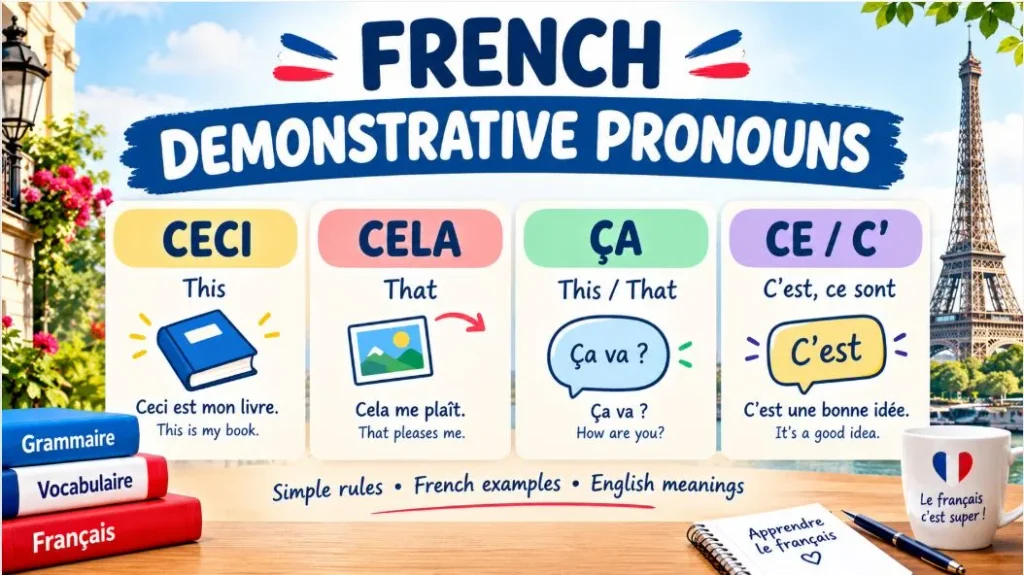
Quick answer: French indefinite or neutral demonstrative pronouns include ceci (this), cela (that), and ça (this, that, or it). They refer to a thing, an idea, an action, or a situation without naming it directly. The form ce, usually seen in c’est and ce sont, is also used to identify or comment on something. The best choice depends on the sentence and the context.
Learning French demonstrative pronouns will help you express opinions, refer to things you have already mentioned, and talk more naturally about everyday situations. In this guide, you will learn how to use ceci, cela, ça, and ce, understand the differences between them, and practise with simple French examples.
What Are French Indefinite Demonstrative Pronouns?
French demonstrative pronouns are words that point to or refer to a person, thing, idea, or situation. Unlike demonstrative adjectives or determiners, they do not accompany a noun.
For example:
- Ceci est important. — This is important.
- Cela me plaît. — I like that.
- Ça va ? — How are you? / Is everything okay?
- C’est intéressant. — This is interesting.
The forms ceci, cela, and ça are often called neutral demonstrative pronouns because they do not change according to the gender or number of a noun. The neutral pronoun ce is commonly used with être.
These forms are especially useful when the exact object is unimportant or when you are referring to an entire idea or situation.
Neutral vs. ordinary demonstrative pronouns
French has two important groups of demonstrative pronouns.
| Type | French forms | Example |
|---|---|---|
| Neutral demonstrative pronouns | ceci, cela, ça, ce | Ça me plaît. — I like that. |
| Gender- and number-based demonstrative pronouns | celui, celle, ceux, celles | Je préfère celui-ci. — I prefer this one. |
The second group replaces a specific noun and agrees with its gender and number. The neutral forms refer more generally to things, ideas, or situations.
1. How to Use Ceci in French
Ceci generally means “this.” It can refer to something close to the speaker or introduce something that is about to be explained.
It is correct French, but in everyday conversation, ça is often more natural.
Examples with ceci
- Ceci est très important. — This is very important.
- Veuillez lire ceci attentivement. — Please read this carefully.
- Retenez bien ceci : la pratique est essentielle. — Remember this well: practice is essential.
- Je trouve ceci intéressant. — I find this interesting.
When should you use ceci?
Use ceci when you want to:
- Point to something specific.
- Introduce information that follows.
- Emphasize a point in an explanation.
- Use a more formal or written style.
Tip: You can often replace ceci with ça in casual conversation without changing the basic meaning.
2. How to Use Cela in French
Cela generally means “that,” although it can also mean “this” depending on the context. It frequently refers to an idea, event, or statement that has already been mentioned.
It is suitable for both formal and neutral written French.
Examples with cela
- Cela me fait plaisir. — That makes me happy.
- Je ne comprends pas cela. — I do not understand that.
- Cela semble intéressant. — That seems interesting.
- Merci pour cela. — Thank you for that.
- Cela dépend de la situation. — That depends on the situation.
When should you use cela?
Use cela when you want to:
- Refer back to something already discussed.
- Express an opinion about a situation.
- Write in a neutral or relatively formal style.
- Avoid repeating a whole statement.
For example:
Il a réussi son examen. Cela me rend heureux.
He passed his exam. That makes me happy.
Here, cela refers to the entire preceding situation.
3. How to Use Ça in French
Ça is the shortened form of cela and is extremely common in everyday spoken French. Depending on context, it can mean “this,” “that,” or “it.”
For beginners, learning how to use ça is particularly valuable because it appears in many common expressions.
Examples with ça
- Ça va ? — How are you? / Is everything okay?
- Ça va bien. — I’m doing well.
- J’aime ça. — I like that.
- Ça me plaît. — I like that.
- Ça m’intéresse. — That interests me.
- Ça dépend. — It depends.
- Qu’est-ce que c’est que ça ? — What is that?
- Ça ne marche pas. — It doesn’t work.
When should you use ça?
Use ça when speaking naturally with friends, family, or people in informal situations. It is also common in everyday writing and messages.
Compare:
- Cela me plaît. — That appeals to me. (More neutral or formal.)
- Ça me plaît. — I like that. (More conversational.)
Both are correct. The main difference is the level of formality and the context.
4. How to Use Ce and C’
The neutral demonstrative pronoun ce is commonly used with the verb être. Before a vowel or a silent h, it becomes c’ in standard contractions such as c’est and c’était.
Examples with ce and c’
- C’est une bonne idée. — It’s a good idea.
- C’est difficile. — It’s difficult.
- C’est mon professeur. — This is my teacher.
- C’était intéressant. — It was interesting.
- Ce sont mes amis. — These are my friends.
- Ce sera une belle journée. — It will be a beautiful day.
C’est vs. ce sont
Use c’est with a singular noun or adjective in standard beginner patterns. Use ce sont before plural noun phrases when identifying people or things in careful standard French.
| French | English |
|---|---|
| C’est un livre. | It’s a book. |
| C’est une maison. | It’s a house. |
| Ce sont des livres. | These are books. |
| Ce sont mes collègues. | These are my colleagues. |
In everyday speech, you may hear c’est before plural nouns, but ce sont is the standard form to learn for formal writing and careful speech.
Ce with qui, que, and dont
The pronoun ce also appears in useful expressions that mean “what,” “that which,” or “the thing that.”
- Ce qui — what / that which, when it functions as the subject of the following clause.
- Ce que — what / that which, when it functions as the object of the following clause.
- Ce dont — what / that which, when the construction requires de.
Examples:
Ce qui m’intéresse, c’est le français.
What interests me is French.
Je comprends ce que tu dis.
I understand what you are saying.
Voilà ce dont j’ai besoin.
That’s what I need.
These expressions follow specific grammatical patterns. They are related to neutral demonstrative pronouns but deserve further study as a separate grammar topic.
5. Ceci vs. Cela vs. Ça vs. Ce
The easiest way to choose the correct form is to consider what you are referring to and whether you are speaking or writing.
| Pronoun | Main meaning | Typical use |
|---|---|---|
| Ceci | This | Pointing to something or introducing information |
| Cela | That / this | Referring to an idea or previously mentioned situation |
| Ça | This / that / it | Everyday conversation and informal language |
| Ce / c’ | This / it / that | Commonly used with être and in set expressions |
Compare the forms in context
Ceci est mon livre.
This is my book.
Cela est difficile à expliquer.
That is difficult to explain.
Ça semble difficile.
That seems difficult.
C’est difficile.
It’s difficult.
All four sentences can be grammatically correct, but they differ in construction, emphasis, and naturalness. In everyday conversation, ça semble difficile and c’est difficile are generally more natural than cela est difficile.
Is ceci always “this” and cela always “that”?
Not exactly. Traditional grammar often associates ceci with what is near or about to be mentioned and cela with what is distant or has already been mentioned. In modern French, the distinction is not always strict, and context is important.
In ordinary conversation, French speakers frequently use ça for both “this” and “that.”
6. Common Mistakes to Avoid
Mistake 1: Using ça in every formal sentence
Ça is correct in many contexts, but cela can be more appropriate in formal writing.
Less formal: Ça dépend de la situation.
More formal: Cela dépend de la situation.
Mistake 2: Confusing ce with the demonstrative determiner ce
Compare:
- Ce livre est intéressant. — This book is interesting.
- C’est intéressant. — This is interesting.
In the first sentence, ce comes before the noun livre. It is a demonstrative determiner, not a standalone pronoun. In the second sentence, c’ is part of the neutral demonstrative pronoun construction c’est.
Mistake 3: Using ce instead of ça with every verb
In ordinary statements, use ça with many verbs:
- Correct: Ça m’intéresse. — That interests me.
- Correct: Ça fonctionne. — It works.
- Correct: C’est intéressant. — This is interesting.
The choice depends on the construction, not simply on the English word “it.”
Mistake 4: Thinking ceci and cela always refer to physical objects
They can also refer to ideas, opinions, actions, or complete statements.
Example:
Il ne veut pas venir. Cela me surprend.
He doesn’t want to come. That surprises me.
Here, cela refers to the whole situation.
Mistake 5: Confusing neutral forms with celui, celle, ceux, and celles
Compare:
- Ça est beau is generally not the natural standard choice in ordinary French; say C’est beau or Ça, c’est beau, depending on the meaning.
- Celui-ci est beau. — This one is beautiful.
Use celui-ci when referring to a specific masculine singular item. Use ça when referring more generally to a thing or situation.
7. Practice Exercise: Choose the Correct French Pronoun
Complete each sentence with the most appropriate option: ceci, cela, ça, or c’est.
- ______ me plaît beaucoup. (Informal: I like that a lot.)
- ______ une excellente idée. (It’s an excellent idea.)
- Veuillez lire ______ avant de signer. (Please read this before signing.)
- Il a oublié mon anniversaire. ______ me rend triste. (That makes me sad.)
- ______ va ? (How are you?)
Answers and explanations
- Ça me plaît beaucoup. — Ça is natural in everyday conversation.
- C’est une excellente idée. — Use c’est to identify or describe something.
- Veuillez lire ceci avant de signer. — Ceci suits a formal instruction.
- Cela me rend triste. — Cela refers to the preceding situation.
- Ça va ? — This is a very common everyday expression.
Frequently Asked Questions
1. What are the French indefinite demonstrative pronouns?
The main neutral or indefinite demonstrative forms are ceci, cela, and ça. The form ce is also used as a neutral demonstrative pronoun, especially in constructions such as c’est, ce sont, ce qui, and ce que.
2. What is the difference between ceci and cela?
Ceci traditionally refers to something close or information about to be introduced, while cela often refers to something more distant or already mentioned. The distinction depends on context and is not always strict in modern French.
3. Is ça formal or informal French?
Ça is especially common in spoken and informal French. Cela is often preferred in more formal writing, although the right choice depends on the sentence.
4. Can I use ça instead of cela?
Yes, in many everyday sentences. For example, cela me plaît and ça me plaît both mean “I like that.” However, some fixed expressions and grammatical constructions require special attention.
5. What is the difference between ce and c’est?
Ce is the base form, while c’est combines ce with the verb être. For example, C’est intéressant means “It’s interesting.” Before est, the form contracts to c’.
6. What is the difference between ce and celui?
Ce can be a demonstrative determiner before a noun, as in ce livre (“this book”), or a neutral pronoun in constructions such as c’est. Celui is a masculine singular demonstrative pronoun that replaces a specific noun, as in celui-ci (“this one”).
7. What do ce qui and ce que mean?
Both can mean “what” or “that which.” Use ce qui when the expression is the subject of the following clause and ce que when it is the object.
Examples:
- Ce qui compte, c’est la pratique. — What matters is practice.
- Je sais ce que tu veux. — I know what you want.
Conclusion
French indefinite demonstrative pronouns help you refer to things, ideas, and situations without repeating entire sentences. Remember the basic distinction:
- Ceci: this, often used for emphasis or in more formal contexts.
- Cela: that or this, often used to refer back to an idea or situation.
- Ça: a very common conversational form meaning this, that, or it.
- Ce / c’: used in constructions such as c’est, ce sont, ce qui, and ce que.
The best way to master these forms is to practise them in complete sentences rather than memorizing English translations alone.
Want to improve your French grammar further? Explore more beginner-friendly explanations, examples, and practical lessons on LearnFrenchFromHome.com.