
Learn French Counting from 1 to 100 (Complete Beginner’s Guide)
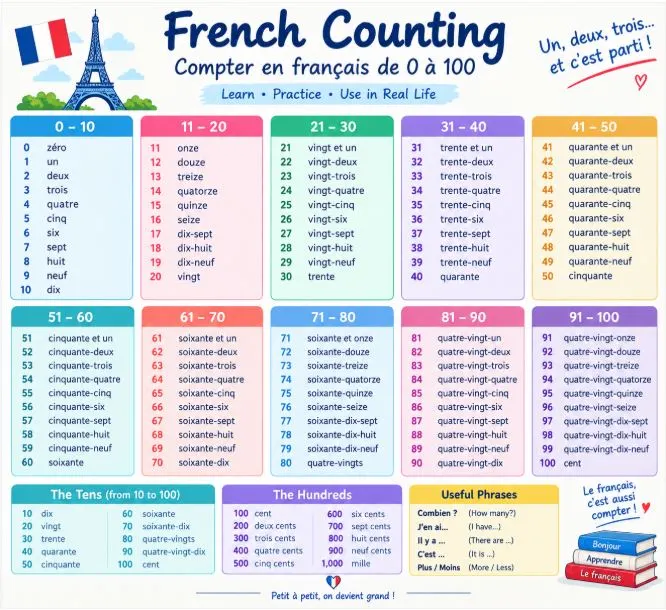
Learning French counting is one of the first and most important steps in mastering the French language. Whether you want to tell the time, ask for prices, give your phone number, or understand dates, knowing French numbers is essential.
In this guide, you’ll learn how to count in French from 1 to 100, understand the rules behind French numbering, avoid common mistakes, and practice with useful examples.
Why Learn French Counting?
French numbers are used every day. Once you master them, you’ll be able to:
- Count objects
- Tell the time
- Say your age
- Read prices
- Understand dates
- Give phone numbers
- Talk about quantities
- Improve your overall French vocabulary
French Numbers 1–20
| Number | French | Pronunciation |
|---|---|---|
| 1 | un | uh(n) |
| 2 | deux | duh |
| 3 | trois | trwah |
| 4 | quatre | katr |
| 5 | cinq | sank |
| 6 | six | sees |
| 7 | sept | set |
| 8 | huit | weet |
| 9 | neuf | nuhf |
| 10 | dix | dees |
| 11 | onze | onz |
| 12 | douze | dooz |
| 13 | treize | trez |
| 14 | quatorze | ka-torz |
| 15 | quinze | kanz |
| 16 | seize | sez |
| 17 | dix-sept | dees-set |
| 18 | dix-huit | dees-weet |
| 19 | dix-neuf | dees-nuhf |
| 20 | vingt | van |
French Counting from 21 to 69
French counting becomes very logical after 20.
Pattern
Tens + Number
Example:
- 21 → vingt et un
- 22 → vingt-deux
- 23 → vingt-trois
Notice that et is used only before un.
Examples:
- 21 → vingt et un
- 31 → trente et un
- 41 → quarante et un
- 51 → cinquante et un
- 61 → soixante et un
Tens in French
| Number | French |
|---|---|
| 20 | vingt |
| 30 | trente |
| 40 | quarante |
| 50 | cinquante |
| 60 | soixante |
Examples
- 34 → trente-quatre
- 47 → quarante-sept
- 52 → cinquante-deux
- 68 → soixante-huit
French Counting from 70–79
French becomes unique here.
Instead of having a separate word for 70, French uses:
60 + 10
Examples
| Number | French |
|---|---|
| 70 | soixante-dix |
| 71 | soixante et onze |
| 72 | soixante-douze |
| 73 | soixante-treize |
| 74 | soixante-quatorze |
| 75 | soixante-quinze |
| 76 | soixante-seize |
| 77 | soixante-dix-sept |
| 78 | soixante-dix-huit |
| 79 | soixante-dix-neuf |
French Counting from 80–99
French uses another special pattern.
80 literally means:
4 × 20
80 = quatre-vingts
Examples
| Number | French |
|---|---|
| 80 | quatre-vingts |
| 81 | quatre-vingt-un |
| 82 | quatre-vingt-deux |
| 83 | quatre-vingt-trois |
| 84 | quatre-vingt-quatre |
| 85 | quatre-vingt-cinq |
| 86 | quatre-vingt-six |
| 87 | quatre-vingt-sept |
| 88 | quatre-vingt-huit |
| 89 | quatre-vingt-neuf |
French Numbers 90–99
French counts:
80 + 10
Examples
| Number | French |
|---|---|
| 90 | quatre-vingt-dix |
| 91 | quatre-vingt-onze |
| 92 | quatre-vingt-douze |
| 93 | quatre-vingt-treize |
| 94 | quatre-vingt-quatorze |
| 95 | quatre-vingt-quinze |
| 96 | quatre-vingt-seize |
| 97 | quatre-vingt-dix-sept |
| 98 | quatre-vingt-dix-huit |
| 99 | quatre-vingt-dix-neuf |
French Number 100
100 = cent
Examples
- 100 → cent
- 101 → cent un
- 105 → cent cinq
- 110 → cent dix
- 125 → cent vingt-cinq
Larger French Numbers
| Number | French |
|---|---|
| 200 | deux cents |
| 300 | trois cents |
| 500 | cinq cents |
| 1,000 | mille |
| 10,000 | dix mille |
| 100,000 | cent mille |
| 1,000,000 | un million |
| 1,000,000,000 | un milliard |
Important French Counting Rules
1. Use “et” Only with Un
Correct:
- vingt et un
- trente et un
- quarante et un
Incorrect:
- vingt-deux et ❌
2. Hyphenate Compound Numbers
Examples
- vingt-deux
- cinquante-six
- quatre-vingt-neuf
3. “Quatre-vingts” Loses the S
80
quatre-vingts ✅
81
quatre-vingt-un ✅
No s after 80 when another number follows.
4. “Cent” Takes an S Only When It Ends the Number
Examples
- deux cents ✅
- trois cents ✅
But
- deux cent un
- deux cent dix
No s here.
Everyday Examples of French Counting
Age
J’ai vingt ans.
I am 20 years old.
Price
Cela coûte trente euros.
It costs thirty euros.
Time
Il est huit heures.
It is eight o’clock.
Phone Number
Mon numéro est zéro six…
Dates
Nous sommes le vingt-cinq décembre.
Common Mistakes Beginners Make
❌ Saying septante in standard French (used in Belgium and Switzerland)
✅ Use soixante-dix in France.
❌ Forgetting et
Wrong:
vingt-un
Correct:
vingt et un
❌ Writing 81 as
quatre-vingts-un
Correct:
quatre-vingt-un
Practice Exercises
Exercise 1
Write these numbers in French.
- 18
- 25
- 31
- 46
- 58
- 63
- 70
- 82
- 94
- 100
Exercise 2
Translate into English.
- vingt-deux
- cinquante
- quatre-vingt-seize
- cent
Quick Revision
Remember these key milestones:
- 20 → vingt
- 30 → trente
- 40 → quarante
- 50 → cinquante
- 60 → soixante
- 70 → soixante-dix
- 80 → quatre-vingts
- 90 → quatre-vingt-dix
- 100 → cent
Frequently Asked Questions (FAQ)
Is French counting difficult?
French counting may seem unusual at first, especially from 70 onward. However, once you understand the patterns, it becomes much easier to remember and use.
Why is 80 “quatre-vingts”?
Historically, French used a vigesimal (base-20) counting system. Therefore, quatre-vingts literally means “four twenties” (4 × 20 = 80).
Why is 70 “soixante-dix”?
In standard French, 70 is formed by adding 10 to 60, resulting in soixante-dix (“sixty-ten”). Some French-speaking regions, such as Belgium and Switzerland, use septante instead.
How can I memorize French numbers faster?
Practice speaking numbers aloud every day, count everyday objects, read prices and dates in French, and regularly test yourself with counting exercises.
Final Thoughts
Mastering French counting is a foundational step toward becoming confident in French. By learning the patterns for numbers from 1 to 100, you’ll be able to handle everyday conversations involving age, prices, dates, time, and quantities with ease.
The key to success is regular practice. Start by memorizing the numbers from 1 to 20, then learn the tens, and finally become comfortable with the unique patterns used from 70 to 99. With consistent practice, French numbers will soon become second nature.