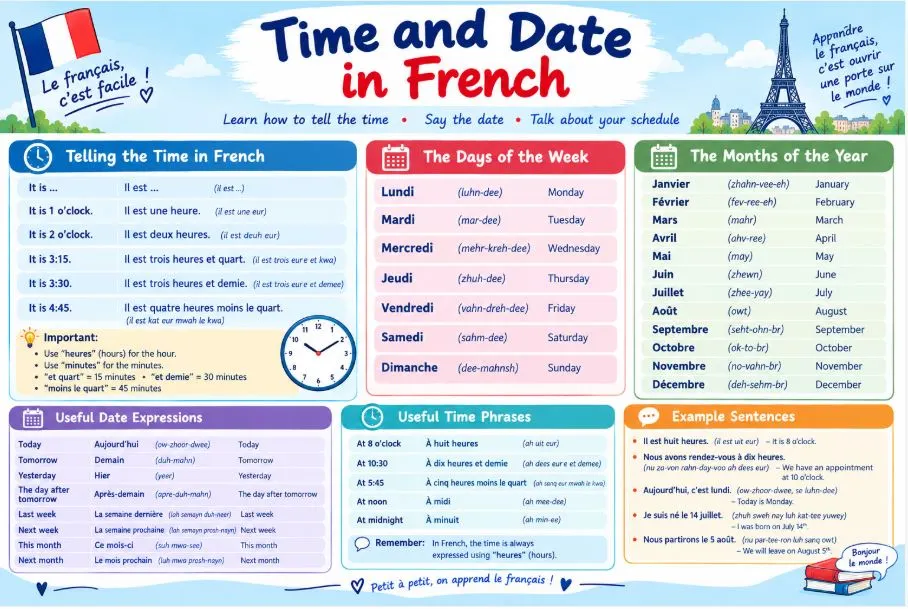
Learning how to talk about time and date in French is essential for everyday communication. Whether you want to make an appointment, ask when a train leaves, talk about your birthday, or describe your daily routine, you need to know how to tell the time and express dates in French.
In this complete guide, you will learn how to tell time in French, how to ask the time, how to say the date, the days of the week, the months of the year, useful time expressions, and common French phrases related to time and dates.
Let’s learn how to talk about time and dates in French step by step.
How to Ask the Time in French
The most common way to ask someone what time it is in French is:
Quelle heure est-il ?
= What time is it?
You can also hear:
Il est quelle heure ?
= What time is it?
The first expression, Quelle heure est-il ?, is more standard and is especially useful for beginners.
Examples
- Quelle heure est-il ? — What time is it?
- Il est quelle heure ? — What time is it?
- Vous avez l’heure ? — Do you have the time?
- Tu as l’heure ? — Do you have the time?
How to Tell Time in French
To tell the time in French, use:
Il est + number + heure(s).
For example:
- Il est une heure. — It is one o’clock.
- Il est deux heures. — It is two o’clock.
- Il est trois heures. — It is three o’clock.
- Il est cinq heures. — It is five o’clock.
Notice that heure is singular after une but plural after other numbers.
Examples
| French | English |
|---|---|
| Il est une heure. | It is one o’clock. |
| Il est deux heures. | It is two o’clock. |
| Il est quatre heures. | It is four o’clock. |
| Il est dix heures. | It is ten o’clock. |
| Il est midi. | It is noon. |
| Il est minuit. | It is midnight. |
French Numbers Used for Telling Time
Before learning more complicated expressions, it is useful to know the numbers from 1 to 24.
| Number | French |
| 1 | un |
| 2 | deux |
| 3 | trois |
| 4 | quatre |
| 5 | cinq |
| 6 | six |
| 7 | sept |
| 8 | huit |
| 9 | neuf |
| 10 | dix |
| 11 | onze |
| 12 | douze |
| 13 | treize |
| 14 | quatorze |
| 15 | quinze |
| 16 | seize |
| 17 | dix-sept |
| 18 | dix-huit |
| 19 | dix-neuf |
| 20 | vingt |
| 21 | vingt et un |
| 22 | vingt-deux |
| 23 | vingt-trois |
| 24 | vingt-quatre |
French commonly uses the 24-hour clock, particularly in schedules, transportation, business, and official situations.
How to Say Minutes in French
To express minutes after the hour, simply add the number of minutes after heure(s).
Examples
Il est deux heures cinq.
= It is 2:05.
Il est trois heures dix.
= It is 3:10.
Il est quatre heures vingt.
= It is 4:20.
Il est six heures vingt-cinq.
= It is 6:25.
Il est huit heures trente.
= It is 8:30.
Important
In everyday French, you may hear both:
Il est huit heures trente.
and
Il est huit heures et demie.
Both mean:
It is 8:30.
Quarter Past, Half Past, and Quarter To in French
French has several useful expressions for describing parts of an hour.
1. Quarter Past — et quart
Et quart means quarter past.
Example:
Il est trois heures et quart.
= It is quarter past three.
Il est neuf heures et quart.
= It is quarter past nine.
2. Half Past — et demie
Et demie means half past.
Example:
Il est deux heures et demie.
= It is half past two.
Il est six heures et demie.
= It is half past six.
The feminine form demie is used because heure is feminine.
3. Quarter To — moins le quart
Moins le quart means quarter to.
Example:
Il est quatre heures moins le quart.
= It is quarter to four.
Il est dix heures moins le quart.
= It is quarter to ten.
How to Say “Five Minutes To” in French
French can express time before the next hour using moins.
For example:
Il est cinq heures moins cinq.
= It is five minutes to five.
Il est sept heures moins dix.
= It is ten minutes to seven.
Il est neuf heures moins vingt.
= It is twenty minutes to nine.
The basic structure is:
Il est + next hour + moins + minutes.
Midnight and Noon in French
Two important expressions are:
Midi
Midi = noon
Example:
Il est midi.
= It is noon.
Minuit
Minuit = midnight
Example:
Il est minuit.
= It is midnight.
You do not normally say une heure de l’après-midi to mean noon. Simply use midi.
AM and PM in French
French often uses the 24-hour clock, especially for formal schedules.
For example:
14 h 00 = 2:00 PM
18 h 30 = 6:30 PM
21 h 15 = 9:15 PM
In informal conversation, French speakers can also clarify the part of the day.
Common expressions
- du matin — in the morning
- de l’après-midi — in the afternoon
- du soir — in the evening
- dans la nuit — during the night
Examples
Il est huit heures du matin.
= It is eight in the morning.
Il est deux heures de l’après-midi.
= It is two in the afternoon.
Il est huit heures du soir.
= It is eight in the evening.
How to Write Time in French
In written French, particularly in schedules and formal contexts, time is commonly written using h.
Examples:
- 8 h 00
- 10 h 30
- 14 h 15
- 18 h 45
- 21 h 00
The h stands for heure.
For example:
Le cours commence à 9 h 30.
= The class starts at 9:30.
Le train part à 18 h 45.
= The train leaves at 6:45 PM.
How to Say “At” a Specific Time in French
When saying that something happens at a particular time, French generally uses the preposition à.
Structure
à + time
Examples:
- à huit heures — at eight o’clock
- à midi — at noon
- à minuit — at midnight
- à trois heures et demie — at half past three
Example Sentences
Je travaille à huit heures.
= I work at eight o’clock.
Le cours commence à neuf heures.
= The class starts at nine o’clock.
Nous nous retrouvons à midi.
= We meet at noon.
Days of the Week in French
Knowing the days of the week in French is essential for talking about dates and schedules.
| English | French |
| Monday | lundi |
| Tuesday | mardi |
| Wednesday | mercredi |
| Thursday | jeudi |
| Friday | vendredi |
| Saturday | samedi |
| Sunday | dimanche |
Important Rule
In French, days of the week are normally written in lowercase.
For example:
lundi ✅
Lundi ❌
unless the word begins a sentence or is used in a title where capitalization is required.
How to Say “On Monday” in French
To say that something happens on a particular day, French commonly uses lundi, mardi, etc., without an article when referring to a specific upcoming occurrence.
Example:
Je travaille lundi.
= I work on Monday.
Nous partons samedi.
= We are leaving on Saturday.
You can also use le + day to express a recurring action.
Je travaille le lundi.
= I work on Mondays.
This distinction is useful:
- lundi → on Monday / this Monday
- le lundi → on Mondays / every Monday
Months of the Year in French
Here are the twelve months in French:
| English | French |
| January | janvier |
| February | février |
| March | mars |
| April | avril |
| May | mai |
| June | juin |
| July | juillet |
| August | août |
| September | septembre |
| October | octobre |
| November | novembre |
| December | décembre |
Like the days of the week, French months are normally written in lowercase.
For example:
janvier ✅
Janvier ❌
How to Say “In January” in French
To say in + month, use:
en + month
Examples:
- en janvier — in January
- en février — in February
- en mars — in March
- en avril — in April
- en juillet — in July
- en décembre — in December
Example
Je vais en France en juillet.
= I am going to France in July.
How to Say the Date in French
French dates follow a different order from American English.
The basic structure is:
day + month + year
For example:
5 juin 2026
= June 5, 2026
In a complete sentence:
Nous sommes le 5 juin 2026.
= Today is June 5, 2026.
To ask the date, you can say:
Quelle est la date aujourd’hui ?
= What is today’s date?
A very common expression is:
On est quel jour ?
= What day is it?
The First Day of the Month: le premier
There is an important exception when saying the first day of a month.
Use:
le premier
rather than le un.
For example:
le premier janvier
= January 1
le premier mai
= May 1
But for other dates, use the ordinary number:
le deux janvier
= January 2
le dix juin
= June 10
le vingt-cinq décembre
= December 25
How to Say the Year in French
Years are generally expressed using French numbers.
Examples:
- 2020 — deux mille vingt
- 2021 — deux mille vingt et un
- 2022 — deux mille vingt-deux
- 2025 — deux mille vingt-cinq
- 2026 — deux mille vingt-six
Example
Je suis né en 1995.
= I was born in 1995.
Nous sommes en 2026.
= We are in 2026.
How to Say “Today” in French
The French word for today is:
aujourd’hui
Examples:
Aujourd’hui, il fait beau.
= Today, the weather is nice.
Nous sommes lundi aujourd’hui.
= Today is Monday.
Aujourd’hui, nous sommes le 10 août.
= Today is August 10.
Useful French Time Expressions
Here are some of the most useful expressions related to time.
| French | English |
| aujourd’hui | today |
| demain | tomorrow |
| hier | yesterday |
| avant-hier | the day before yesterday |
| après-demain | the day after tomorrow |
| maintenant | now |
| bientôt | soon |
| plus tard | later |
| tôt | early |
| tard | late |
| toujours | always |
| souvent | often |
| parfois | sometimes |
| jamais | never |
| chaque jour | every day |
| tous les jours | every day |
| cette semaine | this week |
| la semaine prochaine | next week |
| la semaine dernière | last week |
| ce mois-ci | this month |
| le mois prochain | next month |
| le mois dernier | last month |
Common French Expressions for Time
À bientôt
À bientôt !
= See you soon!
À demain
À demain !
= See you tomorrow!
À plus tard
À plus tard !
= See you later!
À tout à l’heure
À tout à l’heure !
= See you later today!
De temps en temps
De temps en temps
= From time to time / occasionally
Example:
Je regarde des films français de temps en temps.
= I watch French movies from time to time.
How to Talk About the Past, Present, and Future
Three basic expressions are:
In the past
dans le passé
= in the past
At present
actuellement
= currently / at present
In the future
à l’avenir
= in the future
Examples:
Dans le passé, je travaillais à Paris.
= In the past, I worked in Paris.
Actuellement, j’habite en Inde.
= Currently, I live in India.
À l’avenir, je voudrais voyager davantage.
= In the future, I would like to travel more.
How to Say “For” a Period of Time in French
French uses pendant to express a duration.
Examples:
J’ai étudié pendant deux heures.
= I studied for two hours.
Nous sommes restés en France pendant une semaine.
= We stayed in France for a week.
You can also use depuis when an action began in the past and continues into the present.
J’apprends le français depuis deux ans.
= I have been learning French for two years.
How to Say “Since” in French
Use depuis when talking about something that started in the past and is still continuing.
Structure
depuis + period of time
Examples:
Je travaille ici depuis cinq ans.
= I have been working here for five years.
Elle apprend le français depuis six mois.
= She has been learning French for six months.
How to Say “In” a Certain Amount of Time
French uses dans when talking about something that will happen after a certain period.
Examples:
Je reviendrai dans deux heures.
= I will come back in two hours.
Le train part dans dix minutes.
= The train leaves in ten minutes.
Nous partirons dans trois jours.
= We will leave in three days.
Compare:
- depuis deux heures → for two hours, continuing until now
- pendant deux heures → for two hours, duration
- dans deux heures → in two hours, from now
Common Questions About Time and Date in French
What time is it?
Quelle heure est-il ?
What time does the class start?
À quelle heure commence le cours ?
What day is it?
Quel jour sommes-nous ?
What is today’s date?
Quelle est la date aujourd’hui ?
When?
Quand ?
At what time?
À quelle heure ?
What day?
Quel jour ?
What month?
Quel mois ?
Examples: Time and Date in Everyday French
Here are some practical sentences you can use in everyday conversations.
Quelle heure est-il ?
What time is it?
Il est neuf heures.
It is nine o’clock.
Le cours commence à dix heures.
The class starts at ten o’clock.
Nous sommes mardi.
It is Tuesday.
Nous sommes le quinze juin.
It is June 15.
Mon anniversaire est en septembre.
My birthday is in September.
Je travaille du lundi au vendredi.
I work from Monday to Friday.
Je vais partir dans une heure.
I am going to leave in an hour.
J’habite ici depuis trois ans.
I have lived here for three years.
J’ai étudié pendant deux heures.
I studied for two hours.
Time and Date in French: Quick Reference Table
| English | French |
| What time is it? | Quelle heure est-il ? |
| It is one o’clock. | Il est une heure. |
| It is two o’clock. | Il est deux heures. |
| Noon | midi |
| Midnight | minuit |
| Today | aujourd’hui |
| Tomorrow | demain |
| Yesterday | hier |
| Monday | lundi |
| Sunday | dimanche |
| January | janvier |
| December | décembre |
| At eight o’clock | à huit heures |
| In January | en janvier |
| For two hours | pendant deux heures |
| For two years | depuis deux ans |
| In two hours | dans deux heures |
| See you tomorrow | À demain ! |
| See you soon | À bientôt ! |
Common Mistakes to Avoid
1. Capitalizing French Days and Months
French normally uses lowercase for days and months.
lundi ✅
janvier ✅
Not:
Lundi ❌
Janvier ❌
unless capitalization is required by sentence position or a title.
2. Forgetting the Article in Dates
A complete date commonly uses le:
Nous sommes le 15 juin. ✅
3. Saying “le un janvier”
For the first day of a month, use:
le premier janvier ✅
4. Confusing depuis, pendant, and dans
Remember:
depuis → started in the past and continues
pendant → duration
dans → after a period from now
Tips for Learning Time and Dates in French
The best way to memorize French time and date vocabulary is to use it regularly.
1. Practice telling the time
Look at a clock several times a day and say the time in French.
For example:
Il est sept heures et quart.
2. Write today’s date in French
Every day, write:
Nous sommes le [date] [month] [year].
3. Learn the days and months together
Practice saying:
lundi, mardi, mercredi, jeudi, vendredi, samedi, dimanche
Then practice:
janvier, février, mars, avril, mai, juin, juillet, août, septembre, octobre, novembre, décembre
4. Use French in your daily routine
Instead of thinking:
“It’s 8 o’clock.”
Think:
Il est huit heures.
This helps you develop automatic French language skills.
Frequently Asked Questions About Time and Date in French
How do you say “What time is it?” in French?
The standard expression is Quelle heure est-il ? You can also say Il est quelle heure ? in everyday conversation.
How do you say “What is today’s date?” in French?
You can say Quelle est la date aujourd’hui ?
How do you say the date in French?
French generally follows the order day + month + year.
For example:
15 juin 2026
= June 15, 2026.
Do French days and months use capital letters?
Normally, no. Days and months are written in lowercase in French.
How do you say “at 5 o’clock” in French?
Use à cinq heures.
How do you say “in January” in French?
Use en janvier.
What is the difference between midi and minuit?
Midi means noon, while minuit means midnight.
How do you say “for two hours” in French?
For a duration, use pendant deux heures. If the activity started in the past and is still continuing, use depuis deux heures.
Conclusion
Learning time and date in French is an important step toward speaking French confidently in everyday situations. Start by learning the numbers, days of the week, months, and basic expressions such as Quelle heure est-il ?, Il est…, aujourd’hui, demain, and hier.
Once you understand expressions such as à, en, depuis, pendant, and dans, you can talk about appointments, schedules, birthdays, routines, past events, and future plans much more naturally.
The key is regular practice. Try saying the current time and date in French every day, and soon these expressions will become automatic.