
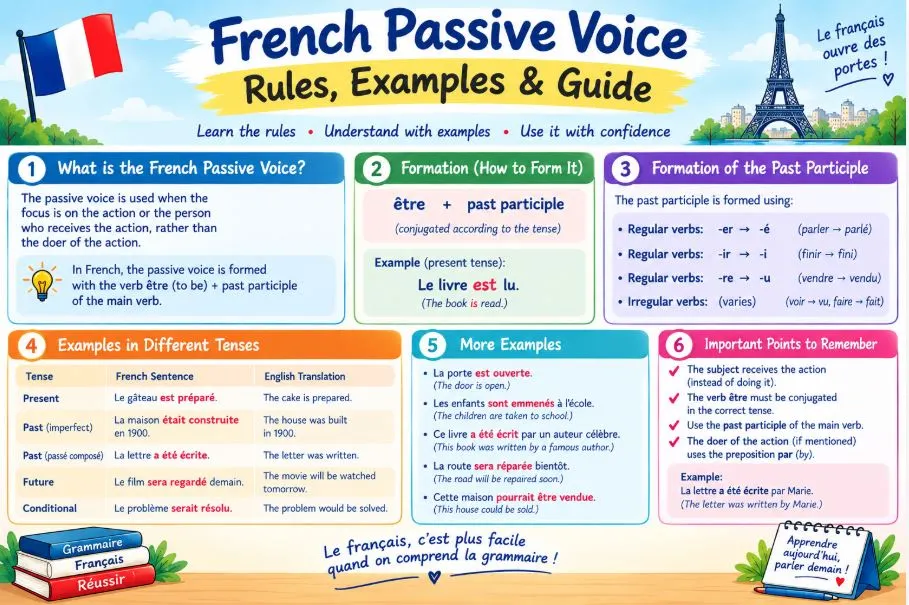
Learning the French passive voice is an important step toward understanding French grammar. Known in French as la voix passive, the passive voice is used when the person or thing receiving an action is more important than the person performing it.
For example:
Marie écrit la lettre.
Marie writes the letter.
Passive voice:
La lettre est écrite par Marie.
The letter is written by Marie.
The basic French passive voice structure is relatively simple: être + past participle. However, you need to pay attention to verb tense, past participle agreement, and the use of par.
In this guide, you will learn the French passive voice rules, how to form passive sentences in different tenses, how to transform active sentences into passive sentences, and common mistakes to avoid.
What Is the French Passive Voice?
The French passive voice is a grammatical construction in which the subject receives the action instead of performing it.
Compare these two sentences:
Active Voice
Le professeur explique la leçon.
The teacher explains the lesson.
Here, le professeur performs the action.
Passive Voice
La leçon est expliquée par le professeur.
The lesson is explained by the teacher.
Here, la leçon receives the action.
The passive voice therefore changes the focus of the sentence.
Active vs. Passive Voice
| Active Voice | Passive Voice |
|---|---|
| Paul ouvre la porte. | La porte est ouverte par Paul. |
| Marie écrit la lettre. | La lettre est écrite par Marie. |
| Le chef prépare le repas. | Le repas est préparé par le chef. |
| Les élèves lisent le livre. | Le livre est lu par les élèves. |
How to Form the Passive Voice in French
The basic formula for the passive voice in French is:
Subject + être + past participle + par + agent
For example:
Le livre est écrit par Victor Hugo.
The book is written by Victor Hugo.
There are four important elements:
- Le livre → the subject receiving the action
- est → conjugated form of être
- écrit → past participle
- par Victor Hugo → the agent performing the action
The active sentence:
Victor Hugo écrit le livre.
becomes:
Le livre est écrit par Victor Hugo.
How to Change an Active Sentence into the Passive
You can usually transform an active sentence into a passive sentence by following four steps.
Step 1: Find the Direct Object
Consider:
Le professeur explique la leçon.
The direct object is:
la leçon
Step 2: Make the Direct Object the New Subject
La leçon…
Step 3: Add the Correct Form of Être
The original sentence is in the present tense, so use:
est
Step 4: Add the Past Participle and Agent
La leçon est expliquée par le professeur.
Complete Transformation
Active:
Le professeur explique la leçon.
Passive:
La leçon est expliquée par le professeur.
This is one of the most useful patterns to practice when learning the French passive voice.
Past Participle Agreement in the French Passive Voice
One of the most important French passive voice rules is past participle agreement.
The past participle agrees in gender and number with the passive subject.
Masculine Singular
Le livre est écrit.
The book is written.
Feminine Singular
La lettre est écrite.
The letter is written.
Masculine Plural
Les livres sont écrits.
The books are written.
Feminine Plural
Les lettres sont écrites.
The letters are written.
Notice the agreement:
| Subject | Past Participle |
| Le livre | écrit |
| La lettre | écrite |
| Les livres | écrits |
| Les lettres | écrites |
This agreement is essential for writing grammatically correct French passive sentences.
French Passive Voice in Different Tenses
The passive voice can be used in several French tenses.
The important point to remember is that être changes according to the tense, while the past participle agrees with the subject.
1. Present Passive
The present passive is formed with:
present tense of être + past participle
Examples:
La maison est construite par les ouvriers.
The house is built by the workers.
Les lettres sont envoyées chaque matin.
The letters are sent every morning.
Le français est parlé dans plusieurs pays.
French is spoken in several countries.
2. Passé Composé Passive
The passé composé passive is formed with:
avoir + été + past participle
Examples:
La maison a été construite en 2020.
The house was built in 2020.
La lettre a été envoyée hier.
The letter was sent yesterday.
Les documents ont été signés.
The documents were signed.
Remember:
été
is the past participle of être.
3. Imparfait Passive
The imperfect passive uses the imperfect form of être + past participle.
Examples:
La maison était construite en pierre.
The house was built in stone.
Les lettres étaient envoyées chaque semaine.
The letters were sent every week.
Le français était enseigné dans cette école.
French was taught in this school.
4. Futur Simple Passive
The future passive uses the future form of être + past participle.
Examples:
La maison sera construite l’année prochaine.
The house will be built next year.
Les résultats seront annoncés demain.
The results will be announced tomorrow.
Le projet sera terminé en juin.
The project will be completed in June.
5. Plus-que-parfait Passive
The plus-que-parfait passive is formed with:
imperfect of avoir + été + past participle
Example:
La maison avait été construite avant notre arrivée.
The house had been built before our arrival.
Another example:
Les documents avaient été envoyés avant la réunion.
The documents had been sent before the meeting.
6. Futur Antérieur Passive
The futur antérieur passive uses:
future of avoir + été + past participle
Example:
La maison aura été construite avant l’hiver.
The house will have been built before winter.
French Passive Voice Tense Chart
Here is a quick reference chart:
| Tense | French Example | English |
| Présent | La porte est ouverte. | The door is opened. |
| Imparfait | La porte était ouverte. | The door was open/opened. |
| Passé composé | La porte a été ouverte. | The door was opened. |
| Futur simple | La porte sera ouverte. | The door will be opened. |
| Plus-que-parfait | La porte avait été ouverte. | The door had been opened. |
| Futur antérieur | La porte aura été ouverte. | The door will have been opened. |
When Do We Use the French Passive Voice?
The French passive voice is particularly useful in several situations.
1. When the Action Is More Important
Sometimes the action matters more than the person performing it.
La voiture a été volée.
The car was stolen.
The identity of the thief is not important or is unknown.
2. When the Agent Is Unknown
The passive voice can be used when we do not know who performed the action.
La fenêtre a été cassée.
The window was broken.
We do not know who broke it.
3. When the Agent Is Obvious
The agent can be omitted when it is obvious from the context.
Le président a été élu.
The president was elected.
There is no need to identify every person involved in the election.
4. In Formal Writing
The passive voice is common in formal, academic, scientific, and administrative writing.
Examples:
Les résultats ont été analysés.
The results were analyzed.
Une nouvelle méthode a été développée.
A new method was developed.
5. In News Reports
News reports frequently use passive constructions.
Plusieurs personnes ont été arrêtées.
Several people were arrested.
Une nouvelle loi a été adoptée.
A new law was passed.
Using “Par” in the French Passive Voice
The preposition par is normally used to introduce the person or thing performing the action.
Examples:
Le tableau a été peint par Monet.
The painting was painted by Monet.
La lettre a été écrite par Marie.
The letter was written by Marie.
Le livre a été traduit par un professionnel.
The book was translated by a professional.
Active
Marie écrit la lettre.
Passive
La lettre est écrite par Marie.
In the passive sentence, Marie is the agent.
Par vs. De in the French Passive Voice
French sometimes uses de instead of par, especially with certain verbs expressing feelings, attitudes, or relationships.
For example:
Il est aimé de tous.
He is loved by everyone.
Elle est respectée de ses collègues.
She is respected by her colleagues.
However, par is the normal choice when explicitly identifying the agent of an action.
For example:
Le livre a été écrit par Victor Hugo.
For beginners, a useful rule is:
Use par when you want to identify who performed the action.
Can Every French Verb Be Used in the Passive Voice?
No.
The standard French passive voice generally requires a transitive verb that takes a direct object.
For example:
Le professeur explique la leçon.
The verb expliquer has a direct object:
la leçon
Therefore, it can form a passive sentence:
La leçon est expliquée par le professeur.
However, verbs that do not take a direct object generally cannot form the standard passive construction.
For example:
Paul dort.
The verb dormir does not have a direct object, so it cannot normally be transformed into a standard passive sentence.
Passive Voice Without “Par”
You do not always have to mention the agent.
For example:
La porte est fermée.
The door is closed.
You could add:
La porte est fermée par le gardien.
The door is closed by the guard.
But if the identity of the guard is not important, the agent can be omitted.
More examples:
Les résultats seront publiés demain.
The results will be published tomorrow.
La maison a été vendue.
The house was sold.
Le problème a été résolu.
The problem was solved.
French Passive Voice Examples
Use these examples to reinforce the structure.
| Active | Passive |
| Paul ouvre la porte. | La porte est ouverte par Paul. |
| Marie écrit une lettre. | Une lettre est écrite par Marie. |
| Le chef prépare le repas. | Le repas est préparé par le chef. |
| Les élèves lisent le livre. | Le livre est lu par les élèves. |
| La police arrête le suspect. | Le suspect est arrêté par la police. |
| L’entreprise construit la maison. | La maison est construite par l’entreprise. |
| Le professeur corrige les exercices. | Les exercices sont corrigés par le professeur. |
| Les ouvriers construisent le pont. | Le pont est construit par les ouvriers. |
Common French Passive Voice Mistakes
1. Forgetting Être
Incorrect:
La lettre écrite par Marie.
Correct:
La lettre est écrite par Marie.
The standard passive construction requires the appropriate form of être.
2. Forgetting Past Participle Agreement
Incorrect:
La lettre est écrit par Marie.
Correct:
La lettre est écrite par Marie.
Because la lettre is feminine singular, écrit becomes écrite.
3. Using the Wrong Form of Être
Incorrect:
Les lettres est envoyées.
Correct:
Les lettres sont envoyées.
The verb être must agree with the subject.
4. Using “À” Instead of “Par”
Incorrect:
Le livre a été écrit à Victor Hugo.
Correct:
Le livre a été écrit par Victor Hugo.
When identifying the agent, par is generally used.
French Passive Voice vs. Active Voice
Although the passive voice is grammatically important, French speakers often prefer the active voice when it is clearer and more direct.
Active
Le professeur explique la règle.
The teacher explains the rule.
Passive
La règle est expliquée par le professeur.
The rule is explained by the teacher.
Both sentences are correct, but they emphasize different things.
The active voice emphasizes the teacher.
The passive voice emphasizes the rule.
Therefore, choose the passive voice when the receiver of the action is the main focus.
A Simple Formula to Remember
If you are a beginner, remember this formula:
ÊTRE + PAST PARTICIPLE
And, when necessary:
ÊTRE + PAST PARTICIPLE + PAR + AGENT
For example:
Le livre est écrit par l’auteur.
Le livre → receiver
est → être
écrit → past participle
par → agent marker
l’auteur → performer
French Passive Voice Practice
Try transforming these active sentences into the passive voice.
Exercise 1
Le professeur explique la leçon.
Answer:
La leçon est expliquée par le professeur.
Exercise 2
Marie écrit la lettre.
Answer:
La lettre est écrite par Marie.
Exercise 3
Les ouvriers construisent le pont.
Answer:
Le pont est construit par les ouvriers.
Exercise 4
La police a arrêté le suspect.
Answer:
Le suspect a été arrêté par la police.
Exercise 5
L’entreprise construira la maison.
Answer:
La maison sera construite par l’entreprise.
Frequently Asked Questions About the French Passive Voice
What is the French passive voice?
The French passive voice, or la voix passive, is a construction in which the subject receives the action. It is generally formed with être + past participle.
Example:
La porte est ouverte par Paul.
How do you form the passive voice in French?
Use:
Subject + être + past participle + par + agent
For example:
Le livre est lu par Marie.
Does the past participle agree in the French passive voice?
Yes. The past participle agrees in gender and number with the passive subject.
Examples:
La lettre est écrite.
Les lettres sont écrites.
Do you always need “par” in a French passive sentence?
No. You can omit the agent when it is unknown, obvious, or unimportant.
Example:
La porte est fermée.
Can every French verb be used in the passive voice?
No. Standard passive constructions generally require transitive verbs that take a direct object.
What is the difference between active and passive voice in French?
In the active voice, the subject performs the action:
Marie écrit la lettre.
In the passive voice, the subject receives the action:
La lettre est écrite par Marie.
Conclusion
The French passive voice, or la voix passive, is easier to understand once you remember its basic structure:
Être + past participle
When the person performing the action needs to be identified, add:
par + agent
The three most important rules are:
- Use the correct form of être.
- Make the past participle agree with the passive subject.
- Use par when identifying the agent in a standard passive construction.
Start with simple present-tense sentences and then practice the passive voice in the passé composé, imparfait, futur simple, plus-que-parfait, and other tenses.
The more active-to-passive transformations you practice, the easier it becomes to recognize and use the French passive voice naturally.
Quick Reminder
Active: Marie écrit la lettre.
Passive: La lettre est écrite par Marie.
Learning this pattern gives you a strong foundation for understanding French passive voice rules and examples in both everyday and formal French.