
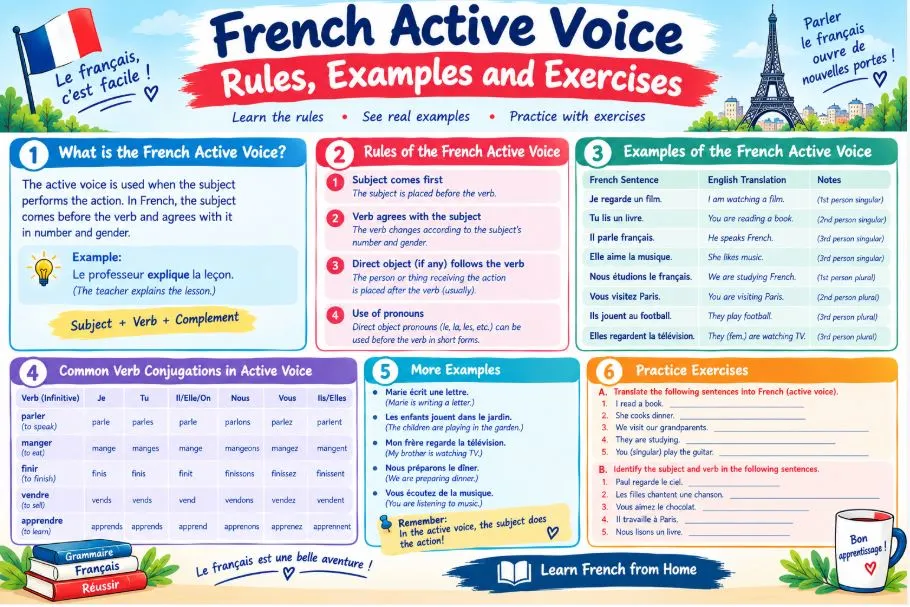
The French active voice is one of the most common sentence structures in French. It is used when the subject of a sentence performs the action.
For example:
Marie écrit une lettre.
Marie writes a letter.
In this sentence, Marie performs the action of writing.
The French active voice is generally straightforward because the basic sentence structure is similar to English:
Subject + Verb + Object
In this guide, you will learn the French active voice rules, how to form active sentences, how active voice works in different tenses, how to distinguish active and passive voice, and how to practice using active sentences correctly.
What Is the French Active Voice?
The French active voice, called la voix active in French, is a sentence structure in which the subject performs the action expressed by the verb.
For example:
Paul mange une pomme.
Paul eats an apple.
Here:
- Paul = subject
- mange = verb
- une pomme = direct object
Paul performs the action, so the sentence is in the active voice.
Basic Structure
The most common structure is:
Subject + Verb + Object
Examples:
Marie lit un livre.
Marie reads a book.
Le professeur explique la leçon.
The teacher explains the lesson.
Les enfants jouent au football.
The children play football.
Active Voice vs. Passive Voice in French
Understanding the difference between active and passive voice is important for French grammar.
Active Voice
Le professeur explique la leçon.
The teacher explains the lesson.
The subject le professeur performs the action.
Passive Voice
La leçon est expliquée par le professeur.
The lesson is explained by the teacher.
The subject la leçon receives the action.
Comparison
| Active Voice | Passive Voice |
|---|---|
| Marie écrit la lettre. | La lettre est écrite par Marie. |
| Paul ouvre la porte. | La porte est ouverte par Paul. |
| Le chef prépare le repas. | Le repas est préparé par le chef. |
| Les élèves lisent le livre. | Le livre est lu par les élèves. |
Simple Rule
Active voice: The subject does the action.
Passive voice: The subject receives the action.
How to Form an Active Sentence in French
The most common French active sentence follows this structure:
Subject + Verb + Object
For example:
Marie + mange + une pomme.
Marie eats an apple.
Here:
- Marie = subject
- mange = verb
- une pomme = object
More examples:
Jean regarde la télévision.
Jean watches television.
Sophie achète une voiture.
Sophie buys a car.
Nous préparons le dîner.
We prepare dinner.
Les enfants dessinent une maison.
The children draw a house.
The Subject in French Active Sentences
The subject is the person, animal, or thing performing the action.
French subjects can be nouns or subject pronouns.
Examples with Nouns
Marie travaille.
Marie works.
Le garçon joue.
The boy plays.
Les étudiants étudient.
The students study.
Examples with Pronouns
Je travaille.
I work.
Tu étudies.
You study.
Il parle.
He speaks.
Elle chante.
She sings.
Nous mangeons.
We eat.
Vous travaillez.
You work.
Ils jouent.
They play.
Elles étudient.
They study.
French Subject Pronouns
Subject pronouns are extremely important because the verb changes according to the subject.
| French | English | Example |
| je | I | Je travaille. |
| tu | you | Tu travailles. |
| il | he/it | Il travaille. |
| elle | she/it | Elle travaille. |
| on | one/we | On travaille. |
| nous | we | Nous travaillons. |
| vous | you | Vous travaillez. |
| ils | they | Ils travaillent. |
| elles | they | Elles travaillent. |
The subject pronoun determines the form of the verb.
For example:
Je parle.
Nous parlons.
Ils parlent.
The verb parler changes according to the subject.
Subject-Verb Agreement in French
One of the most important French active voice rules is subject-verb agreement.
The verb must agree with the subject in person and number.
For example:
Je parle.
Tu parles.
Il parle.
Nous parlons.
Vous parlez.
Ils parlent.
The subject determines which form of the verb should be used.
Another Example
The verb finir:
| Subject | Verb |
| Je | finis |
| Tu | finis |
| Il/Elle | finit |
| Nous | finissons |
| Vous | finissez |
| Ils/Elles | finissent |
Therefore:
Nous finissons le travail.
We finish the work.
Not:
Nous finit le travail.
French Active Voice in Different Tenses
The active voice can be used in virtually every French tense.
The tense changes the verb, but the basic relationship remains the same:
Subject → performs the action
1. Present Tense
The present tense is used for actions happening now, habitual actions, and general facts.
Examples:
Marie mange une pomme.
Marie eats an apple.
Paul travaille à Paris.
Paul works in Paris.
Nous apprenons le français.
We are learning French.
Les enfants jouent dans le jardin.
The children play in the garden.
2. Passé Composé
The passé composé is commonly used to describe completed actions in the past.
Examples:
Marie a écrit une lettre.
Marie wrote a letter.
Paul a acheté une voiture.
Paul bought a car.
Nous avons regardé un film.
We watched a movie.
Ils ont terminé le travail.
They finished the work.
The subject performs the action in each sentence.
3. Imparfait
The imparfait is often used for habitual, ongoing, or background actions in the past.
Examples:
Marie lisait un livre.
Marie was reading a book.
Paul travaillait chaque jour.
Paul worked every day.
Nous regardions la télévision.
We were watching television.
Les enfants jouaient dans le jardin.
The children were playing in the garden.
4. Futur Simple
The futur simple describes actions that will happen in the future.
Examples:
Marie écrira une lettre.
Marie will write a letter.
Paul achètera une voiture.
Paul will buy a car.
Nous visiterons Paris.
We will visit Paris.
Ils termineront le projet demain.
They will finish the project tomorrow.
5. Plus-que-parfait
The plus-que-parfait describes an action that happened before another past action.
Examples:
Marie avait déjà mangé.
Marie had already eaten.
Paul avait terminé son travail.
Paul had finished his work.
Nous avions acheté les billets.
We had bought the tickets.
6. Futur Antérieur
The futur antérieur describes an action that will have been completed before another future event.
Examples:
Marie aura terminé son travail.
Marie will have finished her work.
Nous aurons acheté les billets.
We will have bought the tickets.
Ils auront terminé le projet.
They will have finished the project.
Active Voice with Transitive Verbs
Many French active sentences contain a direct object.
For example:
Marie lit un livre.
Here:
- Marie = subject
- lit = verb
- un livre = direct object
Another example:
Le professeur explique la leçon.
- Le professeur = subject
- explique = verb
- la leçon = direct object
These sentences can generally be transformed into the passive voice.
Active
Le professeur explique la leçon.
Passive
La leçon est expliquée par le professeur.
This is an important connection between French active voice and passive voice.
Active Voice with Intransitive Verbs
Not every active sentence has a direct object.
For example:
Paul dort.
Paul sleeps.
The verb dormir does not take a direct object.
Another example:
Marie arrive.
Marie arrives.
These sentences are active because the subjects perform the actions, but they cannot normally be transformed into the standard passive construction.
Active Voice with Indirect Objects
French active sentences can also contain indirect objects.
For example:
Marie parle à son professeur.
Marie speaks to her teacher.
Here:
- Marie = subject
- parle = verb
- à son professeur = indirect complement
The subject still performs the action.
Another example:
Paul téléphone à sa mère.
Paul calls his mother.
The phrase à sa mère is not a direct object.
Active Voice with Reflexive Verbs
Reflexive verbs are also commonly used in active sentences.
For example:
Je me lève à sept heures.
I get up at seven o’clock.
Elle se prépare rapidement.
She gets ready quickly.
Nous nous promenons dans le parc.
We take a walk in the park.
The subject performs the action, sometimes on themselves.
Active Voice with Modal Expressions
French active sentences can also contain expressions such as:
- devoir → must / have to
- pouvoir → can / be able to
- vouloir → want to
Examples:
Je dois terminer le travail.
I have to finish the work.
Elle peut parler français.
She can speak French.
Nous voulons apprendre le français.
We want to learn French.
The subject remains the performer of the action.
Why Is the Active Voice Common in French?
The active voice is generally direct, clear, and easy to understand.
Compare:
Le professeur explique la règle.
with:
La règle est expliquée par le professeur.
Both are correct.
However, the first sentence is more direct because the person performing the action appears immediately as the subject.
French commonly uses active constructions in everyday conversation because they make it clear who is doing what.
When Should You Use the French Active Voice?
The active voice is particularly useful when:
1. You want to emphasize the person performing the action
Marie prépare le dîner.
Marie is preparing dinner.
2. You want a direct sentence
Paul a réparé la voiture.
Paul repaired the car.
3. You are speaking conversational French
Le professeur explique la règle.
The teacher explains the rule.
4. The agent is important
La police a arrêté le suspect.
The police arrested the suspect.
The focus is on la police.
Active Voice and Word Order in French
French usually follows a relatively fixed word order.
The most common pattern is:
Subject + Verb + Object
For example:
Paul mange une pomme.
French:
Paul → mange → une pomme
English:
Paul → eats → an apple
This similarity makes basic French active sentences relatively easy for English speakers to understand.
Common Mistakes with French Active Voice
Mistake 1: Incorrect Subject-Verb Agreement
Incorrect:
Nous parle français.
Correct:
Nous parlons français.
The verb must agree with nous.
Mistake 2: Using the Wrong Subject Pronoun
Incorrect:
Elles travaille beaucoup.
Correct:
Elles travaillent beaucoup.
Elles requires the third-person plural form.
Mistake 3: Incorrect Word Order
For a simple sentence, avoid unnecessarily changing the standard word order.
Correct:
Marie lit un livre.
The basic structure is:
Subject + Verb + Object
Mistake 4: Confusing Direct and Indirect Objects
Compare:
Je regarde le film.
I watch the movie.
and:
Je parle à Marie.
I speak to Marie.
le film is a direct object, while à Marie is an indirect complement.
Understanding this distinction is particularly important when learning how active sentences relate to passive constructions.
Active Voice vs. Passive Voice: Quick Comparison
| Feature | Active Voice | Passive Voice |
| French name | La voix active | La voix passive |
| Focus | Performer | Receiver |
| Basic structure | Subject + verb + object | Subject + être + past participle |
| Example | Marie écrit la lettre. | La lettre est écrite par Marie. |
| Common in conversation | Very common | Less common |
| Agent required? | Subject is normally explicit | Can be omitted |
French Active Voice Examples
Here are some useful French active voice examples for beginners.
Everyday Actions
Je prépare le petit-déjeuner.
I prepare breakfast.
Elle fait ses devoirs.
She does her homework.
Nous regardons un film.
We are watching a movie.
Ils jouent au football.
They play football.
Work and Study
Le professeur explique la grammaire.
The teacher explains grammar.
Les étudiants étudient le français.
The students study French.
Paul écrit un rapport.
Paul writes a report.
Daily Routine
Je me lève à sept heures.
I get up at seven o’clock.
Je prends une douche.
I take a shower.
Je prends mon petit-déjeuner.
I have breakfast.
Je vais au travail.
I go to work.
Active Voice Exercises
Now test your understanding of the French active voice.
Exercise 1: Identify the Subject
Find the subject in each sentence.
- Marie lit un livre.
- Paul prépare le dîner.
- Les enfants jouent dans le jardin.
- Nous apprenons le français.
- Le professeur explique la leçon.
Answers
- Marie
- Paul
- Les enfants
- Nous
- Le professeur
Exercise 2: Identify the Verb
Find the verb in each sentence.
- Marie écrit une lettre.
- Paul mange une pomme.
- Nous regardons un film.
- Ils étudient le français.
- Le chef prépare le repas.
Answers
- écrit
- mange
- regardons
- étudient
- prépare
Exercise 3: Identify the Object
Find the direct object where there is one.
- Marie lit un livre.
- Paul dort.
- Le professeur explique la leçon.
- Nous regardons un film.
- Les enfants jouent.
Answers
- un livre
- No direct object
- la leçon
- un film
- No direct object
Exercise 4: Change the Verb
Change the verb according to the subject.
Example:
Je ___ français. (parler)
Answer:
Je parle français.
Practice
- Nous ___ le français. (apprendre)
- Ils ___ un livre. (lire)
- Elle ___ le dîner. (préparer)
- Vous ___ beaucoup. (travailler)
- Tu ___ une lettre. (écrire)
Answers
- Nous apprenons le français.
- Ils lisent un livre.
- Elle prépare le dîner.
- Vous travaillez beaucoup.
- Tu écris une lettre.
Exercise 5: Active or Passive?
Identify whether each sentence is active or passive.
- Marie écrit la lettre.
- La lettre est écrite par Marie.
- Paul prépare le repas.
- Le repas est préparé par Paul.
- Les élèves lisent le livre.
Answers
- Active
- Passive
- Active
- Passive
- Active
Active-to-Passive Practice
Try transforming the following active sentences into the passive voice.
1.
Le professeur explique la leçon.
Answer:
La leçon est expliquée par le professeur.
2.
Marie écrit la lettre.
Answer:
La lettre est écrite par Marie.
3.
Le chef prépare le repas.
Answer:
Le repas est préparé par le chef.
4.
Les ouvriers construisent le pont.
Answer:
Le pont est construit par les ouvriers.
5.
La police arrête le suspect.
Answer:
Le suspect est arrêté par la police.
Frequently Asked Questions About the French Active Voice
What is the French active voice?
The French active voice, or la voix active, is a sentence structure in which the subject performs the action.
Example:
Marie écrit une lettre.
What is the basic French active voice structure?
The most common structure is:
Subject + Verb + Object
For example:
Paul mange une pomme.
What is the difference between active and passive voice in French?
In the active voice, the subject performs the action:
Marie écrit la lettre.
In the passive voice, the subject receives the action:
La lettre est écrite par Marie.
Is the active voice common in French?
Yes. The active voice is very common in everyday French and is generally preferred when you want a sentence to be direct and clear.
Can every French active sentence become passive?
No. Standard passive constructions generally require a transitive verb with a direct object.
For example:
Marie lit un livre.
can become:
Un livre est lu par Marie.
But:
Paul dort.
cannot normally be transformed into a standard passive sentence because dormir has no direct object.
How do you recognize an active sentence in French?
Ask:
Who performs the action?
If the grammatical subject performs the action, the sentence is generally active.
Example:
Le garçon ouvre la porte.
The boy performs the action of opening, so the sentence is active.
French Active Voice: Key Takeaways
The French active voice is one of the most important sentence structures to master when learning French.
Remember these key points:
- La voix active means the active voice.
- The subject performs the action.
- The basic structure is Subject + Verb + Object.
- The verb must agree with the subject.
- Active voice is extremely common in everyday French.
- Transitive active sentences can often be transformed into passive sentences.
- Not every active sentence can be changed into the standard passive voice.
- Active voice generally makes sentences direct and clear.
The easiest way to recognize the active voice is to ask:
Who is doing the action?
If the subject is performing the action, you are probably looking at an active sentence.
Final Example
Active:
Marie écrit la lettre.
Marie writes the letter.
Passive:
La lettre est écrite par Marie.
The letter is written by Marie.
Understanding this difference will give you a strong foundation for learning more advanced French grammar, including passive constructions, object pronouns, reflexive verbs, and more complex sentence structures.
1 thought on “French Active Voice: Rules, Examples and Exercises”