
Quick answer: Use c’est mainly to identify, introduce, or make a general comment. Use il est / elle est mainly to describe a specific person or thing with an adjective, or with a profession/nationality when there is no article.
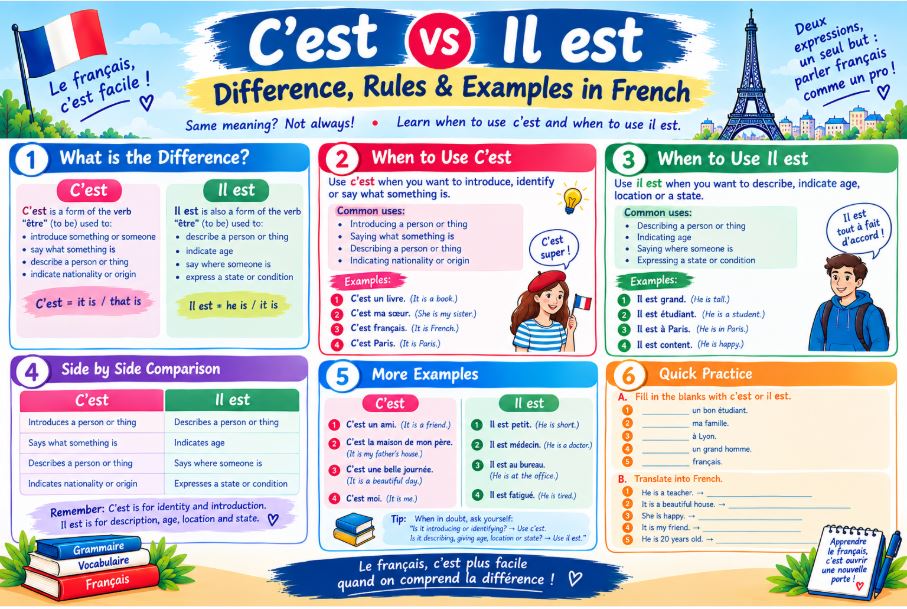
Table of Contents
- C’est vs Il est: The Basic Difference
- What Does C’est Mean?
- What Does Il est Mean?
- C’est + Noun: The Main Rule
- Il est + Adjective: The Main Rule
- C’est vs Il est with Professions
- C’est vs Il est with Nationalities
- C’est vs Il est with Adjectives
- C’est for General Opinions
- Il est for Time and Impersonal Expressions
- C’est and Il est Together
- Common Mistakes
- C’est vs Il est: Quick Comparison Table
- Easy Memory Trick
- Practice Exercise
- Frequently Asked Questions
- Conclusion
C’est vs Il est: The Basic Difference
One of the most common questions for French learners is:
What is the difference between c’est and il est?
Both c’est and il est can sometimes be translated as “it is,” “he is,” or “she is.” However, French does not use them in exactly the same way.
The most useful rule is:
C’est + noun
Use c’est when you identify or introduce a person or thing, especially before a noun with a determiner.
Examples:
- C’est un professeur. → He is a teacher. / This is a teacher.
- C’est mon ami. → He is my friend.
- C’est une belle maison. → It is a beautiful house.
- C’est Marie. → This is Marie.
Il est / Elle est + adjective
Use il est or elle est when describing a specific person or thing with an adjective.
- Il est gentil. → He is kind.
- Elle est belle. → She is beautiful.
- Il est intelligent. → He is intelligent.
- Elle est heureuse. → She is happy.
The important point is that the choice depends largely on the grammatical structure, not simply on whether the English translation contains “he,” “she,” or “it.”
What Does C’est Mean?
C’est is a contraction of:
ce + est = c’est
It can mean:
- this is
- that is
- it is
- he/she is, when identifying someone
It is commonly used to introduce, identify, classify, or comment on something or someone.
Examples
C’est Paul.
→ This is Paul.
C’est mon frère.
→ He is my brother.
C’est une voiture.
→ It is a car.
C’est un bon mécanicien.
→ He is a good mechanic.
C’est une excellente avocate.
→ She is an excellent lawyer.
Notice that a noun usually follows c’est with a determiner such as un, une, le, la, mon, ma, cette, etc.
What Does Il est Mean?
Il est consists of:
il + est = il est
It is generally used to describe a specific, already identified person or thing, especially when followed by an adjective.
Examples
Il est beau.
→ He is handsome.
Il est incroyable.
→ He is incredible.
Il est gentil.
→ He is kind.
Il est intelligent.
→ He is intelligent.
For feminine subjects, use elle est:
Elle est belle.
→ She is beautiful.
Elle est intelligente.
→ She is intelligent.
For plural subjects:
- Ils sont → They are
- Elles sont → They are
Example
Paul est gentil. Il est intelligent.
→ Paul is kind. He is intelligent.
The second sentence uses il est because Paul has already been identified.
C’est + Noun: The Main Rule
A very useful rule for beginners is:
C’est + determiner + noun
A determiner can be an article, possessive adjective, demonstrative adjective, etc.
1. C’est + un/une + noun
C’est un médecin.
→ He is a doctor.
C’est une médecin.
→ She is a doctor.
C’est un étudiant.
→ He is a student.
C’est une étudiante.
→ She is a student.
2. C’est + le/la + noun
C’est le professeur.
→ He/She is the teacher.
C’est la directrice.
→ She is the director.
3. C’est + possessive adjective + noun
C’est mon frère.
→ He is my brother.
C’est ma sœur.
→ She is my sister.
C’est leur professeur.
→ He/She is their teacher.
4. C’est + demonstrative + noun
C’est cette voiture.
→ It is this car.
C’est ce livre.
→ It is this book.
C’est cette femme.
→ She is this woman.
Il est + Adjective: The Main Rule
Use il est / elle est when an adjective directly describes a specific person or thing.
Examples
| French | English |
|---|---|
| Il est beau. | He is handsome. |
| Elle est belle. | She is beautiful. |
| Il est gentil. | He is kind. |
| Elle est intelligente. | She is intelligent. |
| Il est incroyable. | He is incredible. |
| Elle est heureuse. | She is happy. |
| Il est grand. | He is tall. |
| Elle est petite. | She is short. |
Compare
C’est un homme beau.
→ He is a handsome man.
Il est beau.
→ He is handsome.
C’est une femme intelligente.
→ She is an intelligent woman.
Elle est intelligente.
→ She is intelligent.
The first sentence identifies the person using a noun phrase. The second describes the person using an adjective.
C’est vs Il est with Professions
This is one of the most important areas for French learners.
C’est + article + profession
When you use an article such as un, une, use c’est.
C’est un avocat.
→ He is a lawyer.
C’est une avocate.
→ She is a lawyer.
C’est un mécanicien.
→ He is a mechanic.
C’est une mécanicienne.
→ She is a mechanic.
Il est / Elle est + profession without an article
When describing someone’s profession, French normally uses il est / elle est + profession without an article.
Il est avocat.
→ He is a lawyer.
Elle est avocate.
→ She is a lawyer.
Il est mécanicien.
→ He is a mechanic.
Elle est mécanicienne.
→ She is a mechanic.
Compare
C’est un avocat.
→ He is a lawyer. / He is an attorney.
Il est avocat.
→ He is a lawyer.
Both are grammatically correct, but the structure is different.
With an adjective
C’est un bon mécanicien.
→ He is a good mechanic.
Il est bon mécanicien.
→ This is possible in certain contexts, but it is much less natural for the basic meaning “He is a good mechanic.”
For learners, the safest pattern is:
C’est + un/une + profession
Il/Elle est + profession
For example:
C’est un excellent avocat.
Il est avocat.
C’est vs Il est with Nationalities
The same principle applies to nationalities.
C’est + article + nationality noun
C’est un Belge.
→ He is Belgian.
C’est une Belge.
→ She is Belgian.
C’est un Canadien.
→ He is Canadian.
C’est une Canadienne.
→ She is Canadian.
Il est / Elle est + nationality adjective
Il est belge.
→ He is Belgian.
Elle est belge.
→ She is Belgian.
Il est canadien.
→ He is Canadian.
Elle est canadienne.
→ She is Canadian.
Notice the difference:
Belge is capitalized when it is used as a noun:
C’est un Belge.
But it is normally lowercase when it is an adjective:
Il est belge.
The same applies to many nationalities.
C’est vs Il est with Adjectives
This is another major rule.
Describing a specific person or thing
Use il est / elle est.
Paul est mon frère. Il est gentil.
→ Paul is my brother. He is kind.
Marie est ma sœur. Elle est intelligente.
→ Marie is my sister. She is intelligent.
J’aime ce vase. Il est magnifique.
→ I like this vase. It is magnificent.
J’aime cette maison. Elle est grande.
→ I like this house. It is big.
Giving a general comment or opinion
Use c’est.
C’est beau !
→ It is beautiful!
C’est incroyable !
→ It is incredible!
C’est intéressant.
→ It is interesting.
C’est important.
→ It is important.
C’est difficile.
→ It is difficult.
This distinction is particularly useful because c’est + adjective is possible when the adjective expresses a general opinion, judgment, or comment.
C’est for General Opinions
This is an important exception to the simple rule “c’est + noun / il est + adjective.”
You can use c’est + adjective when making a general statement.
Examples
C’est beau.
→ It is beautiful.
C’est incroyable.
→ It is incredible.
C’est intéressant.
→ It is interesting.
C’est important d’apprendre le français.
→ It is important to learn French.
C’est difficile de parler français.
→ It is difficult to speak French.
Here, c’est does not describe a clearly identified masculine or feminine noun. Instead, it gives a general evaluation or comment.
Compare
C’est beau.
→ It is beautiful. / That is beautiful.
General comment
Il est beau.
→ He is handsome. / It is beautiful.
Specific masculine person or thing
Elle est belle.
→ She is beautiful. / It is beautiful.
Specific feminine person or thing
This is why translating c’est = it is and il est = he is is not a reliable method.
Il est for Time and Impersonal Expressions
Il est is also used in several expressions where English uses “it is.”
1. Telling the time
French uses il est to tell the time.
Il est deux heures.
→ It is two o’clock.
Il est huit heures.
→ It is eight o’clock.
Il est midi.
→ It is noon.
Il est minuit.
→ It is midnight.
Do not normally say:
❌ C’est deux heures.
Say:
✅ Il est deux heures.
Time is a special and very common use of il est.
2. Impersonal expressions
French also uses il est in expressions such as:
Il est important de pratiquer.
→ It is important to practice.
Il est possible de venir demain.
→ It is possible to come tomorrow.
Il est difficile de comprendre cette règle.
→ It is difficult to understand this rule.
Il est nécessaire de travailler régulièrement.
→ It is necessary to work regularly.
These are impersonal constructions. They do not refer to a particular person.
C’est and Il est Together
You can use both expressions in the same conversation.
For example:
C’est Paul. Il est français.
→ This is Paul. He is French.
C’est mon professeur. Il est très gentil.
→ He is my teacher. He is very kind.
C’est une maison. Elle est magnifique.
→ It is a house. It is magnificent.
C’est un restaurant. Il est excellent.
→ It is a restaurant. It is excellent.
Notice the pattern:
C’est → identifies or introduces
Il/Elle est → describes
This is one of the easiest ways to understand the difference.
Common Mistakes with C’est and Il est
Mistake 1: Translating “he is” directly as il est
English:
He is my brother.
A beginner may think:
❌ Il est mon frère.
The natural French sentence is:
✅ C’est mon frère.
Why?
Because mon frère is a noun phrase introduced by a possessive determiner.
Mistake 2: Using an article after il est with a profession
❌ Il est un avocat.
For the normal statement of someone’s profession:
✅ Il est avocat.
But:
✅ C’est un avocat.
So remember:
C’est + un/une + profession
Il/Elle est + profession
Mistake 3: Using c’est before an adjective describing a specific person
Suppose you are talking about Paul.
❌ C’est intelligent.
if you mean “He is intelligent.”
✅ Il est intelligent.
But if you are making a general comment:
✅ C’est intéressant.
Mistake 4: Using c’est for the time
❌ C’est huit heures.
✅ Il est huit heures.
Mistake 5: Forgetting adjective agreement
Remember that adjectives agree with the person or thing being described.
Il est beau.
Elle est belle.
Il est français.
Elle est française.
Il est incroyable.
Elle est incroyable.
C’est vs Il est: Quick Comparison Table
| Situation | Correct Structure | Example |
| Identify a person | C’est + name | C’est Marie. |
| Identify a thing | C’est + noun phrase | C’est une voiture. |
| Noun with article | C’est + article + noun | C’est un médecin. |
| Noun with possessive | C’est + possessive + noun | C’est mon frère. |
| Describe a person | Il/Elle est + adjective | Elle est gentille. |
| Describe a thing | Il/Elle est + adjective | Elle est grande. |
| Profession without article | Il/Elle est + profession | Il est médecin. |
| Profession with article | C’est + un/une + profession | C’est un médecin. |
| Nationality as adjective | Il/Elle est + nationality | Il est français. |
| Nationality as noun | C’est + un/une + nationality noun | C’est un Français. |
| General opinion | C’est + adjective | C’est magnifique. |
| Tell the time | Il est + time | Il est dix heures. |
| Impersonal expression | Il est + adjective | Il est important de pratiquer. |
The Easiest Way to Remember C’est vs Il est
Ask yourself one simple question:
Am I identifying something or describing something specific?
If you are identifying → use C’EST
C’est un professeur.
C’est mon ami.
C’est Marie.
C’est une belle maison.
If you are describing a specific person or thing → use IL EST / ELLE EST
Il est gentil.
Elle est belle.
Il est intelligent.
Elle est grande.
If you are giving a general comment → use C’EST
C’est beau.
C’est incroyable.
C’est intéressant.
C’est important.
If you are telling the time → use IL EST
Il est trois heures.
This simple decision tree will help you avoid many common mistakes.
C’est vs Il est: More Examples
Person
C’est un homme.
→ He is a man.
Il est grand.
→ He is tall.
Woman
C’est une femme.
→ She is a woman.
Elle est intelligente.
→ She is intelligent.
Profession
C’est un avocat.
→ He is a lawyer.
Il est avocat.
→ He is a lawyer.
C’est une excellente avocate.
→ She is an excellent lawyer.
Elle est avocate.
→ She is a lawyer.
Nationality
C’est un Canadien.
→ He is Canadian.
Il est canadien.
→ He is Canadian.
C’est une Canadienne.
→ She is Canadian.
Elle est canadienne.
→ She is Canadian.
Thing
C’est un vase.
→ It is a vase.
Il est beau.
→ It is beautiful.
C’est une voiture.
→ It is a car.
Elle est rapide.
→ It is fast.
Practice Exercise
Choose c’est, il est, or elle est.
Exercise 1
- ___ un médecin.
- ___ intelligent.
- ___ ma sœur.
- ___ très belle.
- ___ une bonne idée.
- ___ professeur.
- ___ une excellente avocate.
- ___ français.
- ___ important d’étudier.
- ___ huit heures.
Answers
- C’est un médecin.
- Il est intelligent.
- C’est ma sœur.
- Elle est très belle.
- C’est une bonne idée.
- Il est professeur.
- C’est une excellente avocate.
- Il est français.
- C’est important d’étudier.
- Il est huit heures.
Frequently Asked Questions
Is c’est the same as il est?
No. They can have similar English translations, but they are used differently in French.
C’est un médecin.
→ He is a doctor.
Il est médecin.
→ He is a doctor.
Il est intelligent.
→ He is intelligent.
The grammatical structure determines the choice.
Can c’est be followed by an adjective?
Yes.
C’est beau.
C’est intéressant.
C’est incroyable.
C’est important.
This is especially common when expressing a general opinion, judgment, or comment.
Can il est be followed by a noun?
Yes, but the construction is restricted.
With many professions, occupations, and nationalities, il est + noun is used without an article:
Il est médecin.
Il est avocat.
Il est français.
But when the noun has a determiner, use c’est:
C’est un médecin.
C’est mon avocat.
C’est un Français.
Should I say c’est beau or il est beau?
Both can be correct, but they have different meanings.
C’est beau.
→ It is beautiful. / That is beautiful.
A general comment.
Il est beau.
→ He is handsome. / It is beautiful.
A specific masculine person or thing.
Should I say c’est belle or c’est beau?
For a general statement, use:
✅ C’est beau.
If you are describing a specific feminine person or thing:
✅ Elle est belle.
If you identify it with a feminine noun:
✅ C’est une belle maison.
So do not normally say:
❌ C’est belle.
What is the plural of c’est?
The formal plural is:
Ce sont
Examples:
Ce sont mes amis.
→ They are my friends.
Ce sont des étudiants.
→ They are students.
The corresponding personal pronouns are:
Ils sont / Elles sont
Ils sont gentils.
→ They are kind.
Elles sont intelligentes.
→ They are intelligent.
Conclusion
The difference between c’est and il est becomes much easier when you stop translating word-for-word from English.
Remember these four patterns:
1. C’est + noun
C’est un professeur.
2. Il/Elle est + adjective
Il est gentil.
Elle est belle.
3. C’est + general opinion
C’est intéressant.
C’est important.
4. Il est + profession/nationality without an article
Il est professeur.
Il est français.
And remember the most useful shortcut:
C’est identifies. Il/Elle est describes.
Once you understand this distinction, choosing between c’est, il est, and elle est becomes much more natural.
Nice explanation