False Friends in French: 50+ French-English Faux Amis
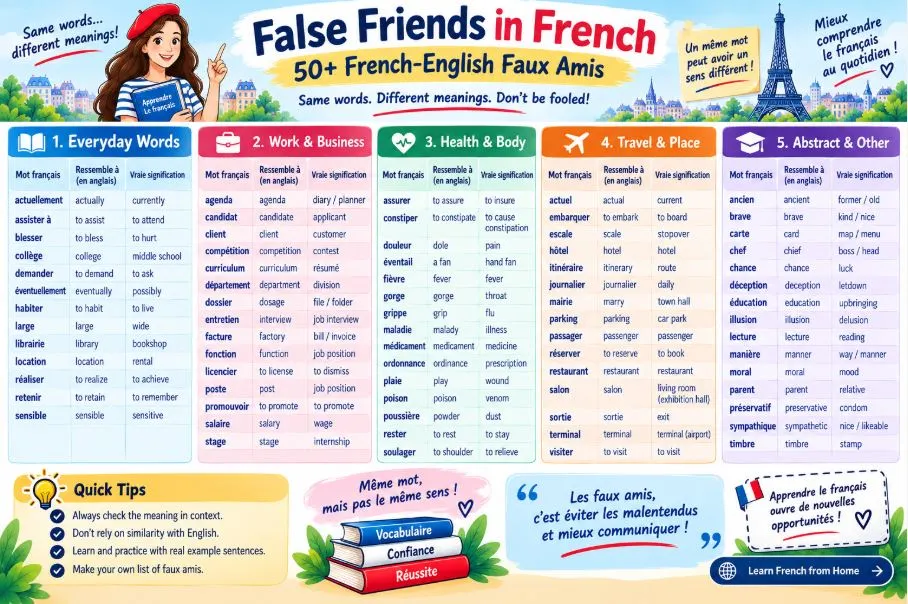
Have you ever seen a French word that looks exactly like an English word and assumed you knew what it meant—only to discover that its meaning is completely different?
These confusing words are called false friends in French, or faux amis in French.
French and English share thousands of words because of their long linguistic history. This can make French vocabulary easier to recognize, but it can also create mistakes when a familiar-looking word has a different meaning.
For example, the French word actuellement looks like the English word “actually.” However, actuellement means currently or at the moment, while “actually” usually means in fact or really.
In this guide, you will learn 50+ common French-English false friends, their real meanings, the English words they resemble, and examples showing how to use them correctly.
What Are False Friends in French?
False friends in French are French and English words that look or sound similar but have different meanings.
They are also called false cognates, although technically not every false friend is a true cognate in the historical-linguistic sense.
In French, false friends are called:
- un faux ami — a false friend
- des faux amis — false friends
- les faux amis — the false friends
The similarity between the two words can make learners automatically assume that they have the same meaning.
Example
French: actuellement
Looks like: actually
Real meaning: currently / at the moment
English “actually”: in fact / really
Example:
Actuellement, j’habite à Paris.
Currently, I live in Paris.
To say “Actually, I live in Paris,” you could say:
En fait, j’habite à Paris.
This is why learning faux amis is so important for French learners.
French False Friends vs. False Cognates
You may see the terms false friends and false cognates used interchangeably.
A false friend is primarily a vocabulary-learning term. It describes a word that looks similar to a word in another language but has a different meaning.
A false cognate is a more technical linguistic term referring to words that appear related because of their form or meaning but do not actually share the same linguistic origin.
For everyday French learning, however, you will frequently see:
false friends = faux amis = false cognates
The important thing is to recognize the misleading similarity and learn the correct meaning.
50+ Common False Friends in French
The following table gives you a quick reference guide to some of the most useful French-English false friends.
| # | French word | Looks like English | Actual French meaning | English equivalent |
|---|---|---|---|---|
| 1 | actuellement | actually | currently | currently |
| 2 | éventuellement | eventually | possibly | possibly |
| 3 | attendre | attend | to wait | wait |
| 4 | assister à | assist | to attend | attend |
| 5 | demander | demand | to ask | ask |
| 6 | librairie | library | bookshop | bookstore |
| 7 | bibliothèque | bibliography/library | library | library |
| 8 | sensible | sensible | sensitive | sensitive |
| 9 | sympathique | sympathetic | nice/friendly | friendly |
| 10 | prétendre | pretend | to claim | claim |
| 11 | rester | rest | to stay | stay |
| 12 | journée | journey | day/daytime | day |
| 13 | collège | college | middle school | middle school |
| 14 | location | location | rental | rental |
| 15 | large | large | wide | wide |
| 16 | avertissement | advertisement | warning | warning |
| 17 | ignorer | ignore | not to know | not know |
| 18 | passer un examen | pass an exam | take an exam | take an exam |
| 19 | réunion | reunion | meeting | meeting |
| 20 | cave | cave | cellar | cellar |
| 21 | actuellement | actually | currently | currently |
| 22 | excité(e) | excited | sexually aroused / excited depending on context | excited |
| 23 | préservatif | preservative | condom | condom |
| 24 | pain | pain | bread | bread |
| 25 | coin | coin | corner | corner |
| 26 | chair | chair | flesh | flesh |
| 27 | affaire | affair | matter/business | matter/business |
| 28 | bras | bra | arm | arm |
| 29 | blessé | blessed | injured | injured |
| 30 | joli | jolly | pretty | pretty |
| 31 | monnaie | money | change/currency | change |
| 32 | race | race | breed | breed |
| 33 | sale | sale | dirty | dirty |
| 34 | main | main | hand | hand |
| 35 | mémoire | memory | memory/recollection | memory |
| 36 | demande | demand | request/application | request |
| 37 | lecture | lecture | reading | reading |
| 38 | entrée | entry | entrance/course | entrance |
| 39 | menu | menu | menu | menu |
| 40 | date | date | date | date |
| 41 | magazine | magazine | magazine | magazine |
| 42 | rester | rest | stay/remain | stay |
| 43 | supporter | support | tolerate/endure | tolerate |
| 44 | réaliser | realize | complete/carry out | accomplish |
| 45 | prévenir | prevent | warn | warn |
| 46 | attendre | attend | wait | wait |
| 47 | car | car | because | because |
| 48 | grand | grand | tall/big | big/tall |
| 49 | actuellement | actually | currently | currently |
| 50 | éventuellement | eventually | possibly | possibly |
| 51 | gratuit | gratuitous | free | free |
| 52 | occasion | occasion | opportunity/event | opportunity |
| 53 | librairie | library | bookstore | bookstore |
| 54 | collège | college | middle school | middle school |
Some pairs are complete false friends, while others are partial false friends: the words may share one meaning but differ in another. This distinction is useful because a word can sometimes be correct in one context and misleading in another.
1. Actuellement ≠ Actually
This is one of the most important French false friends to learn.
Actuellement means:
- currently
- at present
- right now
It does not normally mean “actually.”
Example
Actuellement, je travaille à Paris.
Currently, I work in Paris.
For English “actually,” use expressions such as:
- en fait
- en réalité
- à vrai dire
Example
En fait, je ne suis pas français.
Actually, I am not French.
Memory tip:
actuellement = currently
2. Éventuellement ≠ Eventually
English “eventually” means something that happens in the end or after some time.
French éventuellement usually means:
- possibly
- perhaps
- if necessary
Example
Je peux éventuellement venir demain.
I can possibly come tomorrow.
English “eventually” can be translated as:
- finalement
- à terme
- en fin de compte
Example
Il a finalement accepté.
He eventually accepted.
Memory tip:
éventuellement = possibly, not “eventually.”
3. Attendre ≠ Attend
French attendre means:
to wait
Example
Je t’attends.
I am waiting for you.
English attend means:
to be present at something
Example
I attend French classes every week.
In French:
J’assiste à des cours de français chaque semaine.
4. Assister à ≠ Assist
French assister à means:
to attend / be present at
Example
J’assiste à une réunion.
I am attending a meeting.
English assist means:
to help
In French, “to assist/help” is usually:
aider
Example
Pouvez-vous m’aider ?
Can you help me?
This is one of the most common French-English false friends.
5. Demander ≠ Demand
French demander usually means:
to ask
Example
Je voudrais vous demander quelque chose.
I would like to ask you something.
English demand means:
to demand / insist strongly
French alternatives include:
- exiger
- réclamer
depending on the context.
6. Librairie ≠ Library
This is another essential faux ami.
Une librairie = a bookstore/bookshop.
Une bibliothèque = a library.
Example
Je vais à la librairie acheter un livre.
I’m going to the bookstore to buy a book.
Je vais à la bibliothèque pour étudier.
I’m going to the library to study.
Remember
librairie → bookstore
bibliothèque → library
7. Sensible ≠ Sensible
English sensible means:
- practical
- reasonable
- showing good judgment
French sensible usually means:
- sensitive
- easily affected
- perceptive
Example
Elle est très sensible.
She is very sensitive.
For English “sensible,” French words can include:
- raisonnable
- sensé(e)
- judicieux/judicieuse
depending on the context.
8. Sympathique ≠ Sympathetic
French sympathique commonly means:
- nice
- friendly
- pleasant
Example
Il est très sympathique.
He is very nice.
English sympathetic usually refers to showing understanding or compassion.
French equivalents can include:
- compatissant(e)
- compréhensif/compréhensive
9. Prétendre ≠ Pretend
French prétendre usually means:
to claim / assert
Example
Il prétend être innocent.
He claims to be innocent.
English pretend means:
to act as if something is true when it isn’t.
French equivalents include:
- faire semblant de
- simuler
Example
Il fait semblant de dormir.
He pretends to be sleeping.
10. Rester ≠ Rest
French rester means:
to stay / remain
Example
Je vais rester à la maison.
I am going to stay at home.
English rest means:
to relax or stop working.
French:
se reposer
Example
Je dois me reposer.
I need to rest.
11. Journée ≠ Journey
French journée means:
day / daytime / a period during the day
English journey means:
a trip or voyage.
French equivalents include:
- voyage
- trajet
- déplacement
Example
J’ai passé une bonne journée.
I had a good day.
Le voyage a duré cinq heures.
The journey lasted five hours.
12. Collège ≠ College
This is particularly important for French learners.
French collège refers to a stage of secondary education, generally for students around ages 11–15.
English college usually refers to:
- higher education
- university-level education
- a college as an institution
Example
Mon fils est au collège.
My son is in middle school.
Depending on the educational system, French lycée is closer to high school.
13. Location ≠ Location
French location means:
rental / renting
Example
La location d’une voiture coûte cher.
Renting a car is expensive.
English location means:
place or position.
For example:
The location of the hotel is excellent.
In French, this would be:
L’emplacement de l’hôtel est excellent.
14. Large ≠ Large
French large usually means:
wide / broad
English large generally means:
big / great in size
Example
La rue est très large.
The street is very wide.
For English “large,” French can use:
- grand(e)
- gros/grosse
depending on the context.
15. Avertissement ≠ Advertisement
French avertissement means:
warning
Example
Lisez attentivement l’avertissement.
Read the warning carefully.
An advertisement is:
- une publicité
- une annonce
16. Ignorer ≠ Ignore
French ignorer can mean:
not to know / not to be aware of
Example
J’ignore la réponse.
I don’t know the answer.
English ignore generally means:
deliberately not to pay attention to something or someone.
So:
I don’t know the answer.
is not the same as:
I ignore the answer.
17. Passer un examen ≠ Pass an Exam
This is an especially useful false friend for students.
In French:
passer un examen
means:
to take/sit an exam
Example
Je passe un examen demain.
I have an exam tomorrow.
To say that you successfully passed the exam:
J’ai réussi mon examen.
Therefore:
passer un examen ≠ pass an exam
18. Réunion ≠ Reunion
French réunion usually means:
meeting
Example
J’ai une réunion à 10 heures.
I have a meeting at 10 o’clock.
English reunion means a gathering of people who have been separated for some time.
The French word for that can be:
- retrouvailles
- réunion de famille
depending on the context.
19. Cave ≠ Cave
French cave usually means:
cellar / basement
Example
Le vin est dans la cave.
The wine is in the cellar.
English cave means a natural underground space.
French:
une grotte
20. Excité(e) ≠ Excited
This false friend deserves special attention because it can create an awkward misunderstanding.
French excité(e) can have meanings related to being excited, agitated, or sexually aroused, depending on context.
For ordinary English “I’m excited to see you,” a safer natural French expression is:
J’ai hâte de te voir !
You can also say:
Je suis très enthousiaste !
The meaning depends strongly on context, so learners should be careful with être excité(e).
21. Préservatif ≠ Preservative
This is one of the most famous French-English faux amis.
French:
un préservatif = a condom
English:
preservative = a substance used to prevent food from spoiling
French for “preservative” is usually:
un conservateur
Example
Ce produit contient des conservateurs.
This product contains preservatives.
22. Pain ≠ Pain
French:
le pain = bread
English:
pain = physical or emotional suffering
French:
la douleur = pain
Examples
J’achète du pain.
I’m buying bread.
J’ai mal à la tête.
I have a headache.
23. Coin ≠ Coin
French coin means:
corner / spot / place
Example
Il y a une boulangerie au coin de la rue.
There is a bakery on the corner.
English coin means:
a piece of money
French:
une pièce
24. Chair ≠ Chair
French:
la chair = flesh
English:
chair = chaise
Example
La chair du fruit est tendre.
The flesh of the fruit is soft.
English “chair” is:
une chaise
25. Affaire ≠ Affair
French affaire has several meanings, including:
- matter
- business
- case
- thing/belonging
English affair can mean:
- a romantic relationship
- an event or matter
Example
C’est une affaire importante.
It’s an important matter.
26. Bras ≠ Bra
French:
un bras = an arm
English:
a bra = a type of underwear
French:
un soutien-gorge
27. Blesser ≠ Bless
French blesser means:
to injure / hurt
Example
Il s’est blessé au bras.
He injured his arm.
English bless means:
to invoke divine favor or make holy.
French:
bénir
28. Joli ≠ Jolly
French joli/jolie means:
pretty / attractive / nice-looking
English jolly means:
cheerful / happy / lively
Example
Elle a une jolie robe.
She has a pretty dress.
29. Monnaie ≠ Money
French monnaie can mean:
- change
- coins
- currency
English money is broader.
Example
Avez-vous de la monnaie ?
Do you have some change?
French “money” is commonly:
l’argent
30. Race ≠ Race
French race commonly refers to a breed, particularly of animals.
Example
Quelle est la race de ce chien ?
What breed is this dog?
English race can refer to a competition or historically to categories of people.
For a competition:
une course
31. Sale ≠ Sale
French sale means:
dirty
Example
Cette chemise est sale.
This shirt is dirty.
English sale means:
a period or event when goods are sold at reduced prices.
French:
les soldes
32. Main ≠ Main
French main means:
hand
Example
Donne-moi ta main.
Give me your hand.
English main means:
principal / primary
French equivalents include:
- principal(e)
- essentiel(le)
33. Mémoire ≠ Memory
French mémoire can refer to:
- memory
- recollection
- a written academic dissertation/report
Example
J’ai une bonne mémoire.
I have a good memory.
However, English “memory” can also refer to a specific recollection, for which French often uses:
un souvenir
34. Lecture ≠ Lecture
French lecture means:
reading
Example
La lecture est mon passe-temps préféré.
Reading is my favorite hobby.
English lecture means:
a formal educational talk
French:
un cours magistral
or simply un cours, depending on context.
35. Entrée ≠ Entry
French entrée can mean:
- entrance
- entry
- starter/appetizer, depending on context
In restaurant French, une entrée is generally a starter or appetizer.
Example
Je vais prendre une entrée et un plat principal.
I’ll have a starter and a main course.
36. Supporter ≠ Support
French supporter can mean:
to tolerate / put up with
Example
Je ne peux plus supporter ce bruit.
I can’t stand this noise anymore.
English support can mean:
- help
- encourage
- provide assistance
French equivalents include:
- soutenir
- aider
depending on the context.
37. Réaliser ≠ Realize
French réaliser can mean:
- to accomplish
- to carry out
- to produce
- to make
English realize commonly means:
to become aware of or understand something.
French expressions include:
se rendre compte de
Example
Je me suis rendu compte de mon erreur.
I realized my mistake.
38. Prévenir ≠ Prevent
French prévenir commonly means:
to warn / inform in advance
Example
Préviens-moi quand tu arrives.
Let me know when you arrive.
English prevent means:
to stop something from happening.
French:
empêcher
39. Car ≠ Car
This is an easy one to remember because the spelling is identical.
French:
car = because / for
Example
Je reste à la maison, car il pleut.
I’m staying at home because it is raining.
English:
car = automobile
French:
une voiture
40. Grand ≠ Grand
French grand can mean:
- tall
- big
- large
- great
English grand can mean:
- magnificent
- important
- a thousand dollars
So the words overlap in some contexts but are not interchangeable in every situation.
Example
Il est grand.
He is tall.
How to Learn French False Friends
Simply memorizing a long list of faux amis is not enough. The best approach is to learn each word together with its correct meaning and a complete sentence.
1. Learn the French meaning first
Don’t memorize:
actuellement = actually
Instead memorize:
actuellement = currently
This prevents the incorrect English association.
2. Learn false friends in pairs
Create flashcards such as:
Actuellement → currently
Actually → en fait
Librairie → bookstore
Library → bibliothèque
Attendre → wait
Attend → assister à
This method makes the contrast easier to remember.
3. Use example sentences
Instead of learning isolated vocabulary, learn words in context.
For example:
J’attends le bus.
I’m waiting for the bus.
Then compare:
I attend French classes.
J’assiste à des cours de français.
4. Be careful with words that look familiar
When you encounter an unfamiliar French word that looks exactly like English, don’t automatically assume that you know its meaning.
Ask yourself:
“Is this a French-English false friend?”
This simple habit can prevent many vocabulary mistakes.
5. Group them by topic
You can organize your flashcards into categories:
- Everyday French
- Education
- Travel
- Work
- Food
- Verbs
- Adjectives
- Common conversation
This makes review easier.
The 15 French False Friends You Should Learn First
If you don’t want to memorize all 50+ words immediately, start with these:
- actuellement → currently
- éventuellement → possibly
- attendre → to wait
- assister à → to attend
- demander → to ask
- librairie → bookstore
- sensible → sensitive
- sympathique → friendly
- prétendre → to claim
- rester → to stay
- collège → middle school
- location → rental
- préservatif → condom
- pain → bread
- prévenir → to warn
Mastering these will help you avoid many common mistakes when speaking and writing French.
False Friends in French: Quick Cheat Sheet
| Don’t assume | Remember |
|---|---|
| actuellement = actually | actuellement = currently |
| éventuellement = eventually | éventuellement = possibly |
| attendre = attend | attendre = wait |
| assister = assist | assister à = attend |
| demander = demand | demander = ask |
| librairie = library | librairie = bookstore |
| sensible = sensible | sensible = sensitive |
| sympathique = sympathetic | sympathique = friendly |
| prétendre = pretend | prétendre = claim |
| rester = rest | rester = stay |
| collège = college | collège = middle school |
| location = location | location = rental |
| préservatif = preservative | préservatif = condom |
| pain = pain | pain = bread |
| coin = coin | coin = corner |
| chair = chair | chair = flesh |
| sale = sale | sale = dirty |
| main = main | main = hand |
| lecture = lecture | lecture = reading |
| prévenir = prevent | prévenir = warn |
Why Are There So Many French-English False Friends?
French and English have influenced each other for centuries. English contains a large number of words borrowed from French, while French has also adopted English vocabulary.
Over time, words that originally shared a connection could develop different meanings in the two languages.
This is why a French learner may recognize the spelling of a word but still misunderstand its meaning.
The result is a fascinating group of vocabulary traps known as faux amis.
Are False Friends the Same as Cognates?
Not exactly.
Cognates are words in different languages that share a common linguistic origin and often have related meanings.
For example:
- important — important
- restaurant — restaurant
- possible — possible
These similarities can help you learn French vocabulary.
False friends, on the other hand, create a misleading connection because their meanings differ or have diverged significantly.
The important lesson is:
Similar spelling does not always mean identical meaning.
Frequently Asked Questions About False Friends in French
What is a false cognate in French?
A false cognate in French is a word that looks or sounds similar to a word in another language, especially English, but has a different meaning. French learners commonly call these words faux amis, meaning “false friends.”
What is a faux ami?
Un faux ami means a false friend. It refers to a French word that resembles a word in another language but has a different meaning.
The plural is:
des faux amis
And:
les faux amis = the false friends.
What are the most common false friends in French?
Some of the most common include:
- actuellement / actually
- éventuellement / eventually
- attendre / attend
- assister à / assist
- demander / demand
- librairie / library
- sensible / sensible
- sympathique / sympathetic
- prétendre / pretend
- rester / rest
Does actuellement mean actually in French?
No. Actuellement normally means currently, at present, or right now.
English “actually” is often translated as:
- en fait
- en réalité
- à vrai dire
Does librairie mean library in French?
No. Une librairie means a bookstore or bookshop.
Une bibliothèque means a library.
Does attendre mean attend in French?
No. Attendre means to wait.
English “to attend” can be translated as assister à when talking about being present at an event, class, meeting, or similar activity.
How can I avoid French false friend mistakes?
Learn the French word together with its correct English meaning, study example sentences, compare confusing word pairs, and regularly practice them in context.
Final Thoughts on French False Friends
Learning false friends in French is one of the easiest ways to improve your French vocabulary and avoid common translation mistakes.
Words such as actuellement, éventuellement, attendre, assister à, librairie, sensible, sympathique, rester, location, and préservatif may look familiar to English speakers, but their meanings can be very different.
The best strategy is not to translate these words literally. Instead, learn them as independent French vocabulary items and practice them in complete sentences.
Remember these three French expressions:
un faux ami = a false friend
des faux amis = false friends
les faux amis = the false friends
Once you recognize these vocabulary traps, you’ll become a more accurate and confident French speaker.
Keep this list bookmarked and return to it whenever you encounter a French word that looks suspiciously familiar!