30 French Proverbs With English Meanings | Famous French Sayings
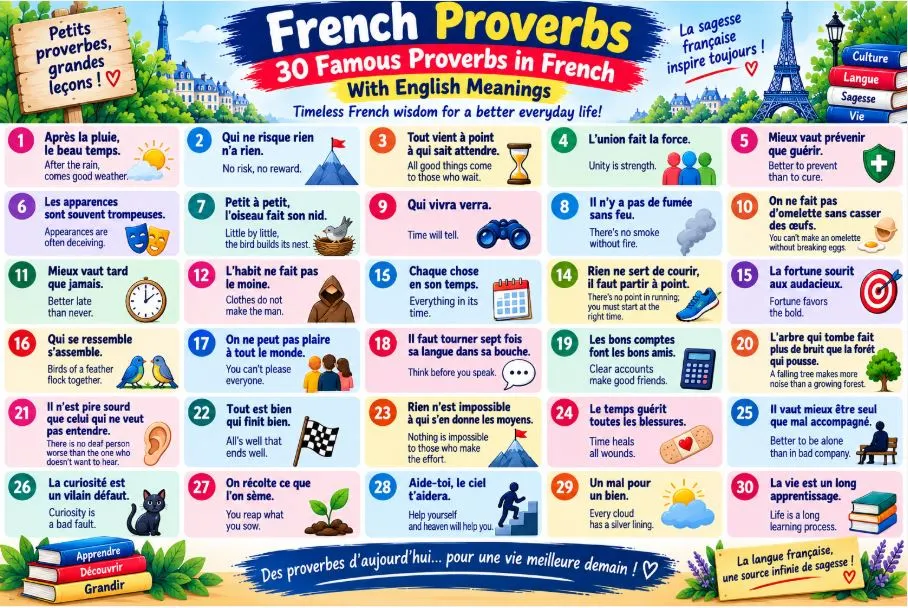
French proverbs are short and memorable expressions that communicate wisdom, advice, observations, and life lessons. They are an excellent way to improve your French vocabulary while discovering how French speakers express common ideas.
Some French proverbs have almost identical English equivalents, while others use completely different images to communicate the same message.
In this article, you will learn 30 French proverbs with English meanings, including useful French proverbs about life, friendship, work, wisdom, patience, and determination.
What Is a French Proverb?
A French proverb is called un proverbe in French.
A proverb usually expresses a general truth, piece of advice, or observation about life.
For example:
Mieux vaut tard que jamais.
Better late than never.
Learning proverbs in French can help you:
- expand your vocabulary
- understand French culture
- recognize common expressions
- improve reading comprehension
- make your French sound more natural
- understand figurative language
30 French Proverbs With English Meanings
Here are the 30 French proverbs featured in this guide. The first 29 come from the supplied reference pages, while number 30 has been added to complete the collection.
| No. | French Proverb | English Meaning |
|---|---|---|
| 1 | Aide-toi, le ciel t’aidera. | God helps those who help themselves. |
| 2 | C’est dans le besoin qu’on reconnaît ses vrais amis. | A friend in need is a friend indeed. |
| 3 | C’est en forgeant qu’on devient forgeron. | Practice makes perfect. |
| 4 | C’est le poêle qui se moque du chaudron. | It’s the pot calling the kettle black. |
| 5 | Charité bien ordonnée commence par soi-même. | Charity begins at home. |
| 6 | Chat échaudé craint l’eau froide. | Once bitten, twice shy. |
| 7 | Chien qui aboie ne mord pas. | Barking dogs seldom bite. |
| 8 | Coucher de poule et lever de corbeau écartent l’homme du tombeau. | Early to bed and early to rise makes a person healthy, wealthy, and wise. |
| 9 | Filer à l’anglaise. | To take French leave. |
| 10 | Force fait loi. | Might is right. |
| 11 | Il faut manger pour vivre, et non vivre pour manger. | Eat to live, don’t live to eat. |
| 12 | Il faut tourner sa langue sept fois dans sa bouche avant de parler. | Think before you speak. |
| 13 | Il n’est jamais trop tard pour bien faire. | It is never too late to mend. |
| 14 | Il n’y a pas de fumée sans feu. | There’s no smoke without fire. |
| 15 | Impossible n’est pas français. | Nothing is impossible. |
| 16 | La fin justifie les moyens. | The ends justify the means. |
| 17 | La parole est d’argent, mais le silence est d’or. | Silence is golden. |
| 18 | L’herbe est toujours plus verte chez le voisin. | The grass is always greener on the other side. |
| 19 | L’erreur est humaine. | To err is human. |
| 20 | Les affaires sont les affaires. | Business is business. |
| 21 | Les amis de nos amis sont nos amis. | A friend of yours is a friend of mine. |
| 22 | Les apparences sont trompeuses. | All that glitters is not gold. |
| 23 | Les chiens aboient, la caravane passe. | Let the world say what it will. |
| 24 | Loin des yeux, loin du cœur. | Out of sight, out of mind. |
| 25 | L’union fait la force. | Union makes strength. |
| 26 | Mieux vaut rire que pleurer. | Laughter is the best medicine. |
| 27 | Mieux vaut tard que jamais. | Better late than never. |
| 28 | Pas de nouvelle, bonne nouvelle. | No news is good news. |
| 29 | Vouloir, c’est pouvoir. | Where there’s a will there’s a way. |
| 30 | Petit à petit, l’oiseau fait son nid. | Little by little, the bird builds its nest. |
10 Best French Proverbs About Life
If you’re specifically looking for Proverbs in French about life, these are particularly useful.
1. Vouloir, c’est pouvoir
English: Where there’s a will there’s a way.
This proverb expresses the importance of determination and motivation.
Vocabulary:
- vouloir = to want
- pouvoir = to be able / can
Example
Je veux apprendre le français. Vouloir, c’est pouvoir !
I want to learn French. Where there’s a will, there’s a way!
2. Mieux vaut tard que jamais
English: Better late than never.
Use this proverb when someone finally does something after delaying it.
J’ai enfin commencé à apprendre le français. Mieux vaut tard que jamais !
3. L’erreur est humaine
English: To err is human.
This proverb reminds us that everyone makes mistakes.
For French learners, it is especially relevant because mistakes are a natural part of learning.
Ne t’inquiète pas pour ton erreur. L’erreur est humaine.
4. Il n’est jamais trop tard pour bien faire
English: It is never too late to mend.
This saying encourages people to correct a mistake or start doing something worthwhile, even after a long delay.
5. L’herbe est toujours plus verte chez le voisin
English: The grass is always greener on the other side.
This is a very useful French proverb about life.
It describes our tendency to believe that someone else’s situation is better than our own.
6. Les apparences sont trompeuses
English: Appearances can be deceptive.
The proverb reminds us not to judge people or situations solely by how they look.
7. Il n’y a pas de fumée sans feu
English: There’s no smoke without fire.
It suggests that a rumor or suspicion may have some underlying cause.
8. Mieux vaut rire que pleurer
English: Laughter is the best medicine.
It encourages a positive attitude, especially during difficult situations.
9. Petit à petit, l’oiseau fait son nid
English: Little by little, the bird builds its nest.
This proverb teaches patience, consistency, and gradual progress.
It is particularly useful for language learners:
Petit à petit, l’oiseau fait son nid.
You don’t need to learn all of French in one day. Learning a few words and expressions every day can eventually produce great results.
10. L’union fait la force
English: Unity makes strength.
This proverb emphasizes the importance of cooperation and teamwork.
French Proverbs About Friendship
French has several beautiful expressions about friendship and relationships.
C’est dans le besoin qu’on reconnaît ses vrais amis.
English: A friend in need is a friend indeed.
The proverb suggests that difficult situations reveal who your true friends are.
Les amis de nos amis sont nos amis.
English: A friend of yours is a friend of mine.
It expresses the idea that friendship can extend through existing relationships.
Loin des yeux, loin du cœur.
English: Out of sight, out of mind.
Literally, it means “far from the eyes, far from the heart.”
French Proverbs About Hard Work and Success
C’est en forgeant qu’on devient forgeron
English: Practice makes perfect.
Literally, the proverb refers to becoming a blacksmith through forging.
The lesson is simple: practice leads to improvement.
This is one of the best French proverbs for language learners.
Aide-toi, le ciel t’aidera
English: God helps those who help themselves.
It encourages personal effort and self-reliance.
Vouloir, c’est pouvoir
English: Where there’s a will there’s a way.
This proverb highlights determination and persistence.
Petit à petit, l’oiseau fait son nid
English: Little by little, the bird builds its nest.
It teaches that consistent small efforts can eventually lead to significant achievements.
French Proverbs About Wisdom
Il faut tourner sa langue sept fois dans sa bouche avant de parler
English: Think before you speak.
Literally:
You should turn your tongue seven times in your mouth before speaking.
It encourages people to think carefully before saying something.
La parole est d’argent, mais le silence est d’or
English: Silence is golden.
Literally:
Speech is silver, but silence is gold.
Sometimes saying nothing is wiser than speaking.
L’erreur est humaine
English: To err is human.
Everyone makes mistakes, and we should recognize this in ourselves and others.
French Proverbs About Appearance and Judgment
C’est le poêle qui se moque du chaudron
English: It’s the pot calling the kettle black.
It describes someone criticizing another person for a fault they also possess.
Les apparences sont trompeuses
English: Appearances are deceptive.
It teaches us not to judge something only by its appearance.
French Proverbs About Patience
Mieux vaut tard que jamais
English: Better late than never.
Il n’est jamais trop tard pour bien faire
English: It is never too late to mend.
Petit à petit, l’oiseau fait son nid
English: Little by little, the bird builds its nest.
Together, these three sayings provide a useful lesson:
Start, be patient, and keep going.
French Proverbs About Everyday Life
Some of these expressions are especially useful in everyday conversations.
Pas de nouvelle, bonne nouvelle
English: No news is good news.
Les affaires sont les affaires
English: Business is business.
Force fait loi
English: Might is right.
Il faut manger pour vivre, et non vivre pour manger
English: Eat to live, don’t live to eat.
Charité bien ordonnée commence par soi-même
English: Charity begins at home.
Interesting French Expressions With Different English Equivalents
One of the most interesting aspects of learning proverbs in French is that the French and English versions don’t always use the same imagery.
For example:
Chat échaudé craint l’eau froide
Literally:
A scalded cat fears cold water.
English equivalent:
Once bitten, twice shy.
L’herbe est toujours plus verte chez le voisin
Literally:
The grass is always greener at the neighbor’s.
English:
The grass is always greener on the other side.
Les chiens aboient, la caravane passe
Literally:
The dogs bark, the caravan passes.
The English equivalent given in the reference is:
Let the world say what it will.
Filer à l’anglaise
Literally:
To leave English-style.
English equivalent:
To take French leave.
This is a particularly interesting cultural difference between French and English expressions.
French Proverbs vs. French Idioms
A French proverb generally expresses a general truth, observation, or piece of advice.
For example:
Mieux vaut tard que jamais.
Better late than never.
A French idiom is a fixed expression whose meaning may not be obvious from the individual words.
For example:
Filer à l’anglaise
doesn’t simply mean “to go English-style.” It is an established expression meaning to leave discreetly or without saying goodbye.
Learning both proverbs and idioms can help you understand natural French more easily.
How to Learn French Proverbs
Don’t try to memorize all 30 French proverbs in one sitting.
Instead, follow these steps.
1. Learn five at a time
Start with five simple expressions.
2. Learn the vocabulary
For example:
Mieux vaut tard que jamais.
Learn:
- mieux = better
- tard = late
- jamais = never
3. Understand the meaning
Don’t memorize only the English translation. Understand the lesson behind the proverb.
4. Make your own sentences
For example:
Je fais des erreurs quand je parle français. L’erreur est humaine.
5. Review regularly
Repetition helps move expressions from short-term memory into long-term memory.
10 French Proverbs Every Beginner Should Know
If you’re a beginner, start with these:
- Bonjour — Hello.
(Note: this is a greeting rather than a proverb.)
For actual proverbs, start with:
- Mieux vaut tard que jamais. — Better late than never.
- Vouloir, c’est pouvoir. — Where there’s a will there’s a way.
- L’erreur est humaine. — To err is human.
- L’union fait la force. — Unity makes strength.
- Il n’y a pas de fumée sans feu. — There’s no smoke without fire.
- Loin des yeux, loin du cœur. — Out of sight, out of mind.
- Les apparences sont trompeuses. — Appearances are deceptive.
- Chien qui aboie ne mord pas. — Barking dogs seldom bite.
- La parole est d’argent, mais le silence est d’or. — Silence is golden.
- Petit à petit, l’oiseau fait son nid. — Little by little, the bird builds its nest.
Frequently Asked Questions About French Proverbs
What are French proverbs?
French proverbs are traditional expressions that communicate wisdom, advice, observations, or general truths.
What is a French proverb about life?
Vouloir, c’est pouvoir is a useful French proverb about life. It means “Where there’s a will, there’s a way.”
Other examples include:
- L’erreur est humaine.
- Mieux vaut tard que jamais.
- Il n’est jamais trop tard pour bien faire.
- L’herbe est toujours plus verte chez le voisin.
- Petit à petit, l’oiseau fait son nid.
What are some Proverbs in French about life?
Some popular Proverbs in French about life include:
Mieux vaut tard que jamais.
Better late than never.
Vouloir, c’est pouvoir.
Where there’s a will there’s a way.
L’erreur est humaine.
To err is human.
Petit à petit, l’oiseau fait son nid.
Little by little, the bird builds its nest.
Why should I learn proverbs in French?
Learning proverbs in French helps you develop vocabulary, understand figurative language, improve comprehension, and become more familiar with French culture and expressions.
What does “Vouloir, c’est pouvoir” mean?
Vouloir, c’est pouvoir means “Where there’s a will there’s a way.” It emphasizes determination and persistence.
What does “Mieux vaut tard que jamais” mean?
It means “Better late than never.” It is used when something happens later than expected but is still worth doing.
What does “Petit à petit, l’oiseau fait son nid” mean?
It literally means “Little by little, the bird builds its nest.” It teaches that consistent effort and patience can gradually lead to success.
Conclusion: Learn French Through Proverbs
French proverbs are a fun and practical way to improve your French while discovering traditional wisdom and cultural expressions.
The 30 expressions in this guide cover important themes such as life, friendship, hard work, patience, wisdom, determination, and everyday situations.
If you are learning French, don’t simply memorize the English translations. Study the French vocabulary, understand the literal imagery, and create your own sentences.
Remember:
C’est en forgeant qu’on devient forgeron.
Practice makes perfect.
And:
Petit à petit, l’oiseau fait son nid.
Little by little, the bird builds its nest.
Keep learning French one word, one expression, and one proverb at a time.