Learning how to introduce yourself in French is one of the first and most useful skills every French learner should master. Whether you are meeting a French speaker, attending a class, traveling to France, starting a new job, or preparing for a French exam, knowing a few simple introduction phrases can help you start a conversation confidently.
The good news is that a self introduction in French does not have to be complicated.
You can start with a greeting, say your name, mention where you are from, talk about your profession or studies, and finish with a polite expression.
In this beginner-friendly guide, you will learn useful French introduction phrases, vocabulary, questions, and complete examples that you can use in real conversations.
How to Introduce Yourself in French
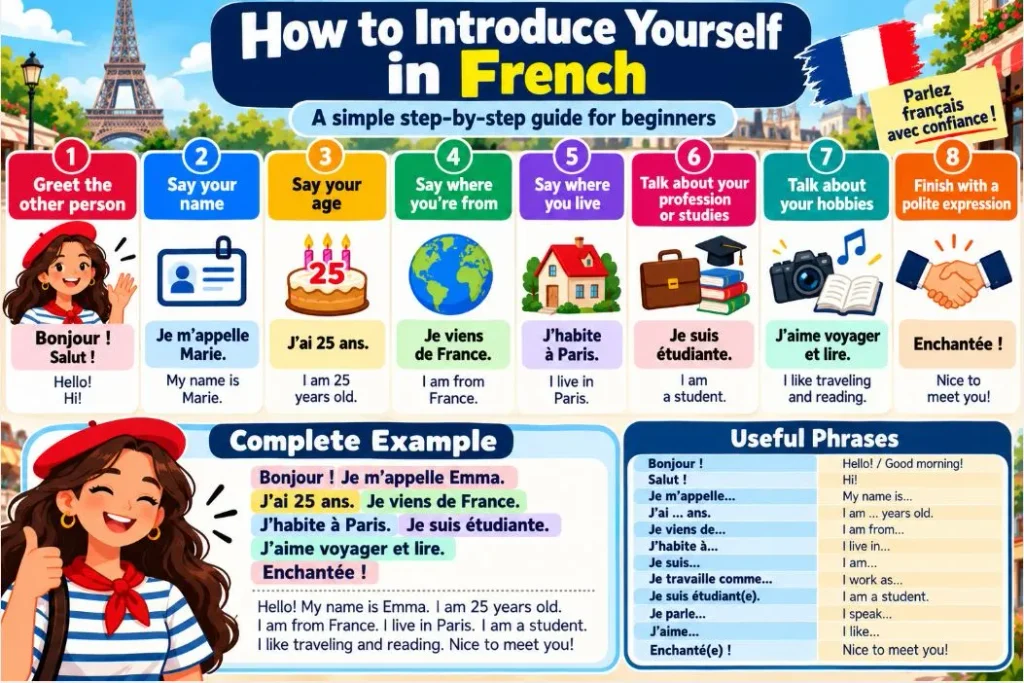
A basic French introduction can follow this simple structure:
Greeting → Name → Age → Nationality → Where you live → Profession/Studies → Hobbies → Nice to meet you
For example:
Bonjour ! Je m’appelle Emma. J’ai 25 ans. Je suis anglaise et j’habite à Londres. Je suis étudiante. J’aime voyager et apprendre le français. Enchantée !
English: Hello! My name is Emma. I am 25 years old. I am English and I live in London. I am a student. I like traveling and learning French. Nice to meet you!
Now, let’s learn each part step by step.
1. Start with a French Greeting
The first step when you introduce yourself in French is to greet the other person.
| French | English |
|---|---|
| Bonjour ! | Hello! / Good morning! |
| Salut ! | Hi! |
| Bonsoir ! | Good evening! |
| Coucou ! | Hi! / Hey! (very informal) |
Which greeting should you use?
Bonjour is the safest choice in most situations.
Use Salut with friends, classmates, or people you already know.
Use Bonsoir when greeting someone in the evening.
Coucou is very informal and is normally used with friends or people you know well.
Example
Bonjour ! Je m’appelle Lucas.
Hello! My name is Lucas.
2. How to Say “My Name Is” in French
The most common way to tell someone your name is:
Je m’appelle + name.
It means:
My name is…
Examples
Je m’appelle Marie.
My name is Marie.
Je m’appelle Paul.
My name is Paul.
You may also hear:
Moi, c’est Paul.
I’m Paul. / As for me, I’m Paul.
This expression is more conversational and informal.
How to Ask Someone’s Name
Comment vous appelez-vous ?
What is your name? — formal/polite
Comment tu t’appelles ?
What’s your name? — informal
3. How to Say Your Age in French
To tell someone your age, French uses the verb avoir (to have) rather than être (to be).
The structure is:
J’ai + number + ans.
Examples
J’ai 20 ans.
I am 20 years old.
J’ai 28 ans.
I am 28 years old.
J’ai 35 ans.
I am 35 years old.
Common Mistake
❌ Je suis 25 ans.
✅ J’ai 25 ans.
Literally, French expresses this as “I have 25 years.”
Asking Someone’s Age
Quel âge avez-vous ?
How old are you? — formal
Quel âge as-tu ?
How old are you? — informal
4. How to Say Where You Are From in French
Another useful part of a French self introduction is explaining where you come from.
Use:
Je viens de/d’ + place
Meaning:
I come from / I am from…
Examples
Je viens de France.
I am from France.
Je viens d’Inde.
I am from India.
Je viens du Canada.
I am from Canada.
Je viens des États-Unis.
I am from the United States.
You can also mention your nationality.
Je suis français.
I am French. — masculine
Je suis française.
I am French. — feminine
Je suis indien.
I am Indian. — masculine
Je suis indienne.
I am Indian. — feminine
Remember that French nationality adjectives often change according to gender.
5. How to Say Where You Live
To tell someone where you live, use:
J’habite à + city
Examples
J’habite à Paris.
I live in Paris.
J’habite à Delhi.
I live in Delhi.
J’habite à Londres.
I live in London.
For countries, the preposition can change.
J’habite en France.
I live in France.
J’habite au Canada.
I live in Canada.
J’habite aux États-Unis.
I live in the United States.
6. Talk About Your Profession
Talking about your job is another common part of a self introduction in French.
Use:
Je suis + profession
Examples
Je suis professeur.
I am a teacher.
Je suis médecin.
I am a doctor.
Je suis comptable.
I am an accountant.
Je suis ingénieur.
I am an engineer.
If you are a student, say:
Je suis étudiant. — male
Je suis étudiante. — female
You can also say:
Je travaille comme professeur.
I work as a teacher.
Je travaille dans le marketing.
I work in marketing.
7. Talk About the Languages You Speak
Languages are a great topic when introducing yourself to someone.
Use:
Je parle + language
Examples
Je parle anglais.
I speak English.
Je parle français.
I speak French.
Je parle hindi et anglais.
I speak Hindi and English.
If you are learning French, you can say:
J’apprends le français.
I am learning French.
Or:
J’étudie le français depuis six mois.
I have been studying French for six months.
8. Talk About Your Hobbies and Interests
A good introduction does more than give your name. Talking about your interests makes it easier to continue the conversation.
Use:
J’aime + noun/infinitive
Examples
J’aime la musique.
I like music.
J’aime voyager.
I like traveling.
J’aime lire.
I like reading.
J’aime regarder des films.
I like watching movies.
J’aime apprendre les langues.
I like learning languages.
You can also use:
Je m’intéresse à…
I am interested in…
Example:
Je m’intéresse à la photographie.
I am interested in photography.
9. How to Say “Nice to Meet You” in French
After introducing yourself, you can say:
Enchanté ! — masculine
Enchantée ! — feminine
Both mean:
Nice to meet you!
In a more formal situation, you can say:
Ravi de vous rencontrer. — masculine
Ravie de vous rencontrer. — feminine
Meaning:
Pleased to meet you.
10. Essential French Introduction Phrases
Here are some useful phrases to memorize:
| French phrase | English meaning |
|---|---|
| Bonjour ! | Hello! |
| Salut ! | Hi! |
| Je m’appelle… | My name is… |
| Moi, c’est… | I’m… |
| J’ai … ans. | I am … years old. |
| Je viens de… | I am from… |
| Je suis… | I am… |
| J’habite à… | I live in… |
| Je travaille comme… | I work as… |
| Je suis étudiant(e). | I am a student. |
| Je parle… | I speak… |
| J’apprends le français. | I am learning French. |
| J’aime… | I like… |
| Je m’intéresse à… | I am interested in… |
| Enchanté(e) ! | Nice to meet you! |
Self Introduction in French Example for Beginners
Here is a simple French self introduction example:
Bonjour ! Je m’appelle Sophie. J’ai 22 ans. Je suis française. J’habite à Lyon. Je suis étudiante. Je parle français et anglais. J’aime la musique, les voyages et la lecture. Enchantée !
English Translation
Hello! My name is Sophie. I am 22 years old. I am French. I live in Lyon. I am a student. I speak French and English. I like music, traveling, and reading. Nice to meet you!
Longer Self Introduction in French
Here is a more detailed example:
Bonjour ! Je m’appelle Thomas. J’ai 30 ans et je viens du Canada. J’habite actuellement à Paris. Je travaille dans le marketing digital. Je parle anglais et un peu français. J’apprends le français parce que j’aime la langue et la culture françaises. Pendant mon temps libre, j’aime voyager, lire, écouter de la musique et faire du sport. Je suis ravi de vous rencontrer !
English Translation
Hello! My name is Thomas. I am 30 years old and I come from Canada. I currently live in Paris. I work in digital marketing. I speak English and a little French. I am learning French because I like the French language and culture. In my free time, I like traveling, reading, listening to music, and playing sports. I am pleased to meet you!
Formal Self Introduction in French
When introducing yourself at work, during an interview, or in another formal situation, use polite language.
For example:
Bonjour. Je m’appelle Pierre Martin. Je suis consultant en marketing. Je travaille dans ce domaine depuis cinq ans. Je suis ravi de faire votre connaissance.
English:
Hello. My name is Pierre Martin. I am a marketing consultant. I have been working in this field for five years. I am pleased to meet you.
In formal situations, remember to use vous rather than tu when addressing someone you do not know well.
Informal Self Introduction in French
When meeting someone casually, your introduction can be much shorter.
Salut ! Moi, c’est Julie. J’ai 24 ans et j’habite à Paris. J’adore voyager et faire du sport. Et toi ?
English:
Hi! I’m Julie. I’m 24 and I live in Paris. I love traveling and playing sports. And you?
Useful Questions After Introducing Yourself
An introduction should ideally lead to a conversation.
Try asking:
Et vous ?
And you? — formal
Et toi ?
And you? — informal
Comment vous appelez-vous ?
What is your name? — formal
Comment tu t’appelles ?
What’s your name? — informal
Vous venez d’où ?
Where are you from? — formal
Tu viens d’où ?
Where are you from? — informal
Qu’est-ce que vous faites dans la vie ?
What do you do for a living? — formal
Qu’est-ce que tu fais dans la vie ?
What do you do for a living? — informal
Quels sont vos loisirs ?
What are your hobbies? — formal
Common Mistakes When Introducing Yourself in French
1. Using être for age
❌ Je suis 25 ans.
✅ J’ai 25 ans.
Use avoir when talking about age.
2. Translating “My name is” word for word
The natural French expression is:
✅ Je m’appelle…
rather than trying to translate every English word literally.
3. Confusing tu and vous
Use tu with friends, family members, children, and people with whom you have an informal relationship.
Use vous in formal situations and when speaking politely to someone you do not know.
4. Forgetting gender agreement
Some words describing nationality, profession, or personal characteristics change depending on gender.
For example:
français → française
étudiant → étudiante
5. Making Your Introduction Too Complicated
Beginners do not need a long speech.
A simple introduction such as:
Bonjour, je m’appelle Anna. Je viens d’Angleterre et j’habite à Paris. Je suis étudiante. J’aime voyager. Enchantée !
is perfectly acceptable.
Simple Formula for a French Self Introduction
Use this template to create your own introduction:
Bonjour/Salut !
Je m’appelle ________.
J’ai ________ ans.
Je viens de/d’ ________.
Je suis ________.
J’habite à ________.
Je suis ________ / Je travaille dans ________.
Je parle ________.
J’aime ________.
Enchanté(e) !
Simply replace the blanks with your personal information.
Practice Exercise
Complete the following sentences about yourself:
- Je m’appelle __________.
- J’ai __________ ans.
- Je viens de/d’ __________.
- J’habite à __________.
- Je suis __________.
- Je parle __________.
- J’aime __________.
- Je m’intéresse à __________.
Now combine your answers into one short paragraph and read it aloud several times.
Frequently Asked Questions
How do you introduce yourself in French?
Start with Bonjour, then say Je m’appelle + your name. You can continue with your age, nationality, location, profession, languages, and hobbies before ending with Enchanté(e).
How do you say “My name is” in French?
The most common expression is:
Je m’appelle…
For example:
Je m’appelle David.
My name is David.
How do you say “I am from” in French?
Use:
Je viens de/d’…
For example:
Je viens d’Inde.
I am from India.
How do you say “I am 25 years old” in French?
Say:
J’ai 25 ans.
French uses the verb avoir (to have) when expressing age.
How do you say “Nice to meet you” in French?
Use:
Enchanté if the speaker is masculine and Enchantée if the speaker is feminine.
What should I include in a French self introduction?
For a basic introduction, include your greeting, name, country or nationality, where you live, profession or studies, languages, hobbies, and a polite closing.
Final Thoughts
Learning how to introduce yourself in French gives you the foundation for starting real conversations.
You do not need advanced French grammar to make a good introduction. Begin with simple expressions such as Bonjour, Je m’appelle, Je viens de, J’habite à, Je suis, and J’aime.
Once you are comfortable with these basic French introduction phrases, gradually add information about your profession, studies, languages, interests, and hobbies.
Most importantly, practice your introduction aloud. The more often you use these phrases, the more naturally you will be able to introduce yourself in French.
À vous maintenant ! Présentez-vous en français !
Now it’s your turn! Introduce yourself in French!