
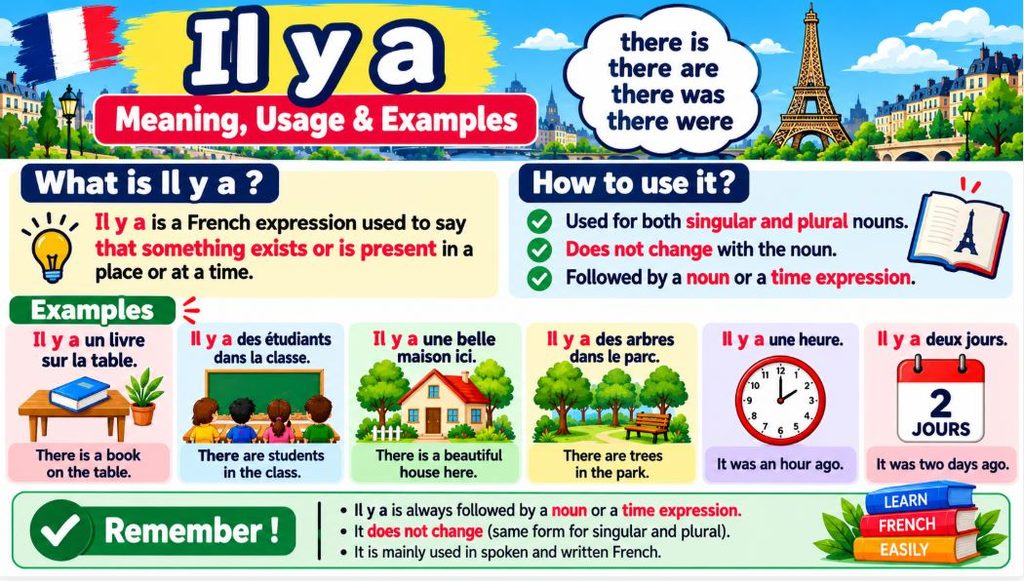
If you are learning French, il y a in French is one of the most useful expressions you can master. You will hear it in everyday conversations and see it frequently in written French.
The expression il y a usually means “there is” or “there are.” However, it can also mean “ago” when talking about time.
For example:
- Il y a un chat dans le jardin. — There is a cat in the garden.
- Il y a trois étudiants dans la classe. — There are three students in the class.
- Je l’ai vu il y a deux jours. — I saw him two days ago.
The good news for beginners is that il y a is relatively easy to use because the basic expression does not change according to whether the noun that follows is singular or plural.
In this guide, you will learn the il y a meaning in French, its grammatical structure, negative form, questions, different tenses, common mistakes, and plenty of practical examples.
What Does Il Y A Mean in French?
The most common il y a meaning is:
Il y a = There is / There are
French uses the same expression for both singular and plural nouns.
| French | English |
|---|---|
| Il y a un livre. | There is a book. |
| Il y a une voiture. | There is a car. |
| Il y a des livres. | There are books. |
| Il y a trois voitures. | There are three cars. |
Notice that il y a remains the same.
English changes:
There is → There are
French does not:
Il y a → Il y a
This makes the expression easier to remember.
Understanding the Structure of Il Y A
The expression can be broken into three parts:
Il + y + a
Il
Il normally means “he” or “it,” but here it works as an impersonal grammatical subject.
Y
Y is an adverbial pronoun that can mean “there” in other French constructions. In il y a, however, it should be learned as part of the complete expression.
A
A comes from the verb avoir, meaning “to have.”
It is the third-person singular form:
Il a = he/it has
Although translating each individual word literally is not particularly helpful, understanding the structure can make the expression easier to remember.
The best approach is to learn:
Il y a = there is / there are
as one complete expression.
How to Use Il Y A in French
The basic structure is:
Il y a + noun
For example:
Il y a un restaurant.
There is a restaurant.
You can then add information about location:
Il y a un restaurant près de l’hôtel.
There is a restaurant near the hotel.
Another example:
Il y a des enfants dans le jardin.
There are children in the garden.
Il Y A With Singular Nouns
Use un or une before a singular countable noun.
Il y a un chien dans le jardin.
There is a dog in the garden.
Il y a une pharmacie près d’ici.
There is a pharmacy near here.
Il Y A With Plural Nouns
For plural indefinite nouns, you will often see des.
Il y a des étudiants dans la classe.
There are students in the classroom.
Il y a des voitures devant la maison.
There are cars in front of the house.
The important rule is that il y a does not become plural.
❌ Ils y ont des étudiants.
✅ Il y a des étudiants.
Il Y A With Numbers and Quantities
You can easily use il y a in French when talking about numbers or quantities.
The structure is:
Il y a + number/quantity + noun
Examples:
Il y a deux chambres dans la maison.
There are two bedrooms in the house.
Il y a cinq personnes dans la voiture.
There are five people in the car.
Il y a beaucoup de touristes ici.
There are many tourists here.
Il y a beaucoup de bruit.
There is a lot of noise.
This construction is extremely useful when describing places, classrooms, houses, cities, shops, restaurants, and other everyday situations.
Il Y A With Partitive Articles
You can also use il y a with the French partitive articles du, de la, and de l’ when talking about an unspecified amount of something.
Examples:
Il y a du pain sur la table.
There is some bread on the table.
Il y a de la soupe.
There is some soup.
Il y a de l’eau dans la bouteille.
There is some water in the bottle.
Negative Form: Il N’Y A Pas
To say “there isn’t” or “there aren’t,” use:
Il n’y a pas…
For example:
Il n’y a pas de problème.
There is no problem.
Il n’y a pas de café.
There is no coffee.
Il n’y a pas d’eau.
There is no water.
Important Article Rule
After il n’y a pas, indefinite and partitive articles generally become de or d’.
Compare:
Il y a un restaurant.
There is a restaurant.
Il n’y a pas de restaurant.
There isn’t a restaurant.
Another example:
Il y a des étudiants.
There are students.
Il n’y a pas d’étudiants.
There aren’t any students.
And:
Il y a du lait.
There is some milk.
Il n’y a pas de lait.
There isn’t any milk.
This is one of the most important il y a French grammar rules for beginners.
How to Ask Questions With Il Y A
There are several ways to form questions using il y a.
1. Intonation
In everyday spoken French, you can simply raise your voice at the end:
Il y a un problème ?
Is there a problem?
Il y a un restaurant près d’ici ?
Is there a restaurant near here?
2. Est-ce que
A very useful neutral structure is:
Est-ce qu’il y a… ?
For example:
Est-ce qu’il y a une banque près d’ici ?
Is there a bank near here?
Est-ce qu’il y a des toilettes ici ?
Are there toilets here?
3. Y a-t-il
In more formal French, you may encounter:
Y a-t-il… ?
For example:
Y a-t-il un problème ?
Is there a problem?
Y a-t-il une solution ?
Is there a solution?
The -t- is inserted to make the pronunciation smoother between the two vowel sounds.
For beginners, Est-ce qu’il y a…? is an especially useful structure to remember.
Il Y A Meaning “Ago”
Here is where il y a becomes particularly interesting.
When followed by a duration of time, il y a can mean:
ago
The structure is:
Il y a + period of time
For example:
Il y a deux jours.
Two days ago.
Il y a trois semaines.
Three weeks ago.
Il y a six mois.
Six months ago.
Il y a dix ans.
Ten years ago.
You can use this structure in complete sentences:
Je l’ai vu il y a deux jours.
I saw him two days ago.
Nous sommes arrivés il y a une heure.
We arrived an hour ago.
J’ai commencé à apprendre le français il y a trois ans.
I started learning French three years ago.
Therefore, context is essential.
Compare:
Il y a deux voitures devant la maison.
There are two cars in front of the house.
But:
Je l’ai acheté il y a deux ans.
I bought it two years ago.
In the first sentence, il y a expresses existence.
In the second, it expresses elapsed time.
Il Y A vs Depuis
French learners often confuse il y a and depuis.
The basic difference is:
Il y a = ago
Depuis = since / for
Use il y a when referring to when a past event happened.
J’ai commencé le français il y a deux ans.
I started French two years ago.
Use depuis when an action or situation started in the past and continues into the present.
J’étudie le français depuis deux ans.
I have been studying French for two years.
Think of it this way:
Il y a → When did it happen?
Depuis → How long has it been continuing?
Il Y A in Different Tenses
The expression can also appear in different tenses because a comes from the verb avoir.
| Tense | French | English |
|---|---|---|
| Present | il y a | there is / there are |
| Imperfect | il y avait | there was / there were |
| Passé composé | il y a eu | there was / there were |
| Future | il y aura | there will be |
| Conditional | il y aurait | there would be |
Let’s examine some examples.
Il Y Avait — There Was / There Were
Il y avait beaucoup de monde au marché.
There were a lot of people at the market.
Il y avait un arbre devant la maison.
There was a tree in front of the house.
Il Y A Eu — There Was / There Were
Il y a eu un accident hier.
There was an accident yesterday.
This form is useful for completed events.
Il Y Aura — There Will Be
Il y aura une réunion demain.
There will be a meeting tomorrow.
Il y aura beaucoup de monde à la fête.
There will be many people at the party.
Il Y Aurait — There Would Be
Il y aurait moins de problèmes avec une meilleure organisation.
There would be fewer problems with better organization.
Il Y A vs C’est
Another common source of confusion is il y a vs c’est.
Use il y a to introduce or state the existence of something.
Il y a un restaurant dans cette rue.
There is a restaurant on this street.
Use c’est to identify or describe something.
C’est un excellent restaurant.
It is an excellent restaurant.
So you might say:
Il y a un restaurant près de chez moi. C’est un restaurant italien.
There is a restaurant near my home. It is an Italian restaurant.
The first sentence introduces the restaurant. The second identifies or describes it.
Il Y A vs Avoir
Do not confuse il y a with ordinary possession using avoir.
For example:
J’ai deux frères.
I have two brothers.
NOT:
Il y a deux frères if your intended meaning is “I have two brothers.”
However:
Il y a deux frères dans la pièce.
There are two brothers in the room.
Use avoir for possession and il y a for existence or presence.
Il Y A in Spoken French
In informal spoken French, you may hear native speakers shorten il y a.
Instead of carefully pronouncing:
Il y a
you may hear something closer to:
Y a
For example:
Y a un problème ?
Is there a problem?
Or:
Y a personne.
There’s nobody.
This type of reduction is common in casual conversation, but learners should continue using the complete il y a form in standard writing.
Common Mistakes With Il Y A
Mistake 1: Changing Il Y A for Plural Nouns
❌ Ils y ont trois voitures.
✅ Il y a trois voitures.
Remember that the expression doesn’t agree with the following noun.
Mistake 2: Forgetting Y
❌ Il a un problème.
✅ Il y a un problème.
These sentences have different meanings.
Il a un problème. = He has a problem.
Il y a un problème. = There is a problem.
Mistake 3: Using the Wrong Article After Negation
❌ Il n’y a pas des restaurants.
✅ Il n’y a pas de restaurants.
Mistake 4: Confusing Il Y A and Depuis
❌ J’étudie le français il y a trois ans.
If you mean that you started three years ago and are still studying:
✅ J’étudie le français depuis trois ans.
If you mean the starting event:
✅ J’ai commencé à étudier le français il y a trois ans.
Mistake 5: Forgetting That Il Y A Can Mean “Ago”
Don’t automatically translate every il y a as “there is” or “there are.”
Look at what follows it.
Il y a + noun → there is / there are
Il y a + duration → ago
20 Useful Il Y A Examples
Here are some practical sentences you can use for practice:
- Il y a un chat dans le jardin. — There is a cat in the garden.
- Il y a deux voitures dehors. — There are two cars outside.
- Il y a beaucoup de monde ici. — There are a lot of people here.
- Il y a du café dans la cuisine. — There is some coffee in the kitchen.
- Il y a une pharmacie près d’ici. — There is a pharmacy near here.
- Il n’y a pas de problème. — There is no problem.
- Il n’y a pas d’eau. — There is no water.
- Est-ce qu’il y a un restaurant ici ? — Is there a restaurant here?
- Y a-t-il une solution ? — Is there a solution?
- Il y a trois chambres dans cette maison. — There are three bedrooms in this house.
- Il y a des nuages dans le ciel. — There are clouds in the sky.
- Il y a quelqu’un à la porte. — There is someone at the door.
- Je l’ai vu il y a deux jours. — I saw him two days ago.
- Nous sommes arrivés il y a une heure. — We arrived an hour ago.
- Il y avait un café ici. — There used to be a café here.
- Il y avait beaucoup de monde. — There were many people.
- Il y a eu un accident. — There was an accident.
- Il y aura une réunion demain. — There will be a meeting tomorrow.
- Il y aura beaucoup de touristes cet été. — There will be many tourists this summer.
- Il y aurait une autre possibilité. — There would be another possibility.
Quick Exercise
Complete each sentence with the correct form.
- ______ un livre sur la table.
- ______ pas de lait dans le réfrigérateur.
- ______ trois étudiants dans la classe.
- Je l’ai rencontré ______ deux ans.
- ______ une réunion demain.
- Quand j’étais enfant, ______ un grand arbre devant notre maison.
Answers
- Il y a un livre sur la table.
- Il n’y a pas de lait dans le réfrigérateur.
- Il y a trois étudiants dans la classe.
- Je l’ai rencontré il y a deux ans.
- Il y aura une réunion demain.
- Quand j’étais enfant, il y avait un grand arbre devant notre maison.
Frequently Asked Questions About Il Y A in French
What does il y a mean in French?
Il y a usually means “there is” or “there are.” When followed by a period of time, it can also mean “ago.”
Does il y a mean both there is and there are?
Yes. French uses il y a with both singular and plural nouns.
Il y a un livre. — There is a book.
Il y a des livres. — There are books.
How do you make il y a negative?
Use:
Il n’y a pas de + noun
Example:
Il n’y a pas de problème.
There is no problem.
How do you ask a question with il y a?
Three common possibilities are:
Il y a un problème ?
Est-ce qu’il y a un problème ?
Y a-t-il un problème ?
All can mean “Is there a problem?” although their level of formality differs.
What does il y a mean with time?
Il y a + duration generally means “ago.”
For example:
Il y a trois jours = three days ago.
What is the difference between il y a and depuis?
Il y a indicates how long ago something happened, while depuis describes something that started in the past and continues.
Je suis arrivé il y a deux ans. — I arrived two years ago.
J’habite ici depuis deux ans. — I have lived here for two years.
Final Thoughts
Learning il y a in French is essential because this small expression has several important uses.
Remember these core rules:
Il y a + noun = there is / there are
Il n’y a pas de + noun = there isn’t / there aren’t
Est-ce qu’il y a…? = Is there / Are there…?
Il y a + duration = ago
Il y avait = there was / there were
Il y aura = there will be
Once you understand these patterns, you can use il y a to describe places, talk about quantities, ask questions, discuss past events, and communicate much more naturally in French.
The best way to master it is to create your own sentences using objects and places around you.
For example:
Il y a un ordinateur sur mon bureau.
Il y a trois fenêtres dans cette pièce.
Il n’y a pas de café.
With regular practice, il y a will quickly become one of the most natural expressions in your French vocabulary.